
OVERVIEW
A U.S.-based consumer technology company focused on digital safety for families found itself at a critical inflection point. Operating at the intersection of SaaS, mobile hardware, and AI-driven monitoring, the business supports hundreds of thousands of families.
Paid search was not a test channel.
It was a primary driver of customer acquisition and revenue.
Cimply was engaged under urgent circumstances following the unexpected departure of a key paid search operator.
What began as a short-term continuity solution quickly evolved into a broader mandate: stabilize performance, support an upcoming peak season, and position the program for long-term scale.
Stabilizing Google Ads and Scaling Performance Without Disruption
What made this engagement unique was not a broken system.
It was a good system at risk of becoming unstable.
KEY RESULTS
- Stabilized campaign performance by reducing volatility caused by high-frequency bid changes
- Increased impression volume and demand capture through refined keyword strategy
- Improved efficiency by introducing a balanced CPA and ROAS optimization framework
- Expanded scalable inventory through the introduction of Performance Max campaigns
- Maintained full continuity during a high-risk ownership transition
- Supported a successful product launch and peak season execution without disruption
PAID SEARCH PROGRAM BACKGROUND
At the time of engagement, the account reflected a high level of prior investment and discipline.
- Over 40 active campaigns aligned to product and intent segmentation
- Managed within Google Ads as the primary execution platform
- Supported by a structured product feed powering Shopping campaigns
- Target CPA bidding strategies implemented across the account
- Reporting pipelines established via ETL into Google Sheets
From a structural standpoint, the system was sound.
But it had lost something more important than structure.
It had lost its operator.
And in paid search, ownership is what maintains stability over time.
GOOGLE ADS PERFORMANCE CHALLENGES
At a glance, the account appeared active and well-managed.
- Frequent bid adjustments
- Ongoing campaign changes
- Heavy use of negative keywords
- Consistent optimization activity
But activity is not the same as effectiveness. The system was being over-managed. Daily bid changes and constant intervention were resetting learning cycles within Google Ads.
Instead of allowing bidding algorithms to stabilize and optimize, the account was caught in a continuous loop of reaction.
This created three core issues:
- Volatility: inconsistent performance due to constant resets
- Constrained scale: limited ability to expand into new demand
- Reduced efficiency: optimization decisions made without sufficient data maturity
This dynamic was further complicated by:
- Limited access to first-party behavioral data
- A legacy structure based on prior-generation best practices
- Unclear long-term ownership
- Imminent peak season pressure, including Black Friday and holiday demand
Nothing was broken. But the system was being pushed in a way that prevented it from performing.
PAID SEARCH OPTIMIZATION STRATEGY
STABILIZATION BEFORE OPTIMIZATION
The first decision was intentional and, in many ways, counterintuitive.
We did not begin by restructuring the account. We began by stabilizing it.
- Maintained existing campaign structure
- Preserved budget pacing
- Avoided unnecessary changes
The goal was simple: allow the system to function as designed.
SLOWING THE OPTIMIZATION CYCLE
The most impactful change was operational.
We shifted from daily interventions to structured optimization windows.
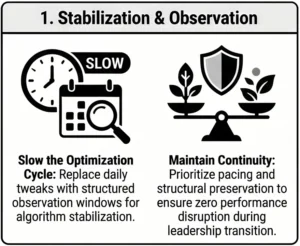
- Reduced bid changes to defined intervals (7–14 days depending on volume)
- Allowed campaigns to accumulate sufficient data before making adjustments
- Evaluated performance over meaningful timeframes rather than daily fluctuations
As a result:
- Performance stabilized
- Volatility decreased
- Campaign behavior became more predictable
Stability improved not because more was done, but because less was done with greater intention.
INTRODUCING A STRUCTURED BID MANAGMENT FRAMEWORK
With stability established, we implemented a more disciplined optimization model.
The framework incorporated:
- Target CPA vs. actual CPA variance
- Revenue contribution and conversion value
- Portfolio-level performance across campaigns
- Tiered bid adjustments based on performance thresholds
This replaced reactive decision-making with a consistent, repeatable system.
EXPANDING DEMAND THORUGH KEYWORD STRATEGY
Negative keyword usage had become overly restrictive, limiting the system’s ability to explore new demand.
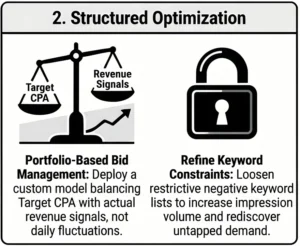 We refined this approach by:
- Removing unnecessary exclusions
- Reintroducing controlled query exploration
- Allowing campaigns to access broader inventory
This increased impression volume and restored the system’s ability to identify incremental opportunities.
EVOLVING PERFORMANCE MEASURMENT
CPA remained important, but it was no longer the only metric guiding decisions.
We expanded the optimization lens to include:
- Return on ad spend (ROAS)
- Revenue contribution
- Efficiency at scale
This allowed for more balanced decision-making between cost control and growth.
EXECUTION DURING PEAK SEASON AND PRODUCT LAUNCH
Two critical moments required focused intervention.
PRODUCT LAUNCH READINESS
A product launch was delayed and operationally incomplete as peak season approached. We stepped in to:
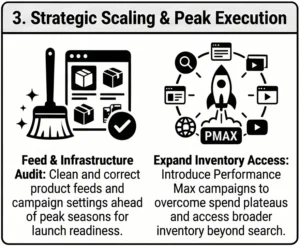
- Clean and correct the product feed
- Ensure campaign readiness
- Align execution with compressed timelines
This was not theoretical strategy.
It was execution under pressure.
SCALING THROUGH PERFORMANCE MAX CAMPAIGNS
As spend increased, performance began to plateau. The limitation was not optimization effort. It was access to inventory. To address this, we introduced Performance Max campaigns within Google Ads.
- Expanded access to additional inventory and placements
- Extended reach beyond existing campaign structures
- Maintained control by layering PMAX alongside core campaigns
This unlocked additional scale without disrupting the existing system.
TRANSITION AND LONG-TERM STRATEGY
As the engagement progressed, our role expanded beyond execution. We supported:
- Long-term account strategy development
- Agency pitch materials and positioning
- Reframing performance from cost-centric to value-based metrics
The engagement ultimately transitioned to a fully staffed agency team, including a director, manager, and associate.
The transition was seamless.
- No performance disruption
- No loss of continuity
- No reset in strategic direction
RESULTS AND BUSINESS IMPACT
The most meaningful outcomes extended beyond individual metrics. The account evolved from a reactive system into a structured, scalable performance engine.

- Reduced volatility through disciplined optimization
- Increased demand capture through improved keyword strategy
- Enabled scalable growth via expanded campaign capabilities
- Maintained performance continuity during a high-risk transition
- Strengthened client confidence and long-term partnership stability
This was not about short-term gains.
It was about building a system that could perform consistently over time.
CLOSING PERSPECTIVE
This was not a case of rebuilding a paid search program. It was a case of stabilizing one that already worked. Well-constructed Google Ads programs do not always require reinvention. More often, they require discipline.
The ability to reduce noise.
The ability to apply structure.
The ability to make decisions with intention.
Sustainable performance is not created through constant activity. It is created through consistent, informed execution.
WORK WITH CIMPLY
If your paid search program is producing results but lacks stability, scalability, or clear ownership, Cimply helps bring structure without disruption. We focus on making systems perform the way they were intended.