

Client Profile
This healthcare marketing measurement case study shows how a nationwide urgent care and primary care provider improved performance visibility across a distributed clinic network during a period of rapid growth and business complexity.
The company operated hundreds of clinics across multiple markets. It supported millions of patient visits each year. Services included urgent care, preventive care, diagnostics, occupational health, and other outpatient services. The goal was to make care easier and more convenient for patients.
From a business standpoint, our client was a well positioned healthcare brand with strong market relevance, a broad geographic footprint, and a value proposition centered around accessible, affordable care.
In terms of healthcare marketing, however, things were less defined.
The operator was actively investing in growth, however, like many distributed healthcare platforms, leadership lacked one clear system for building, measuring, and improving demand across markets.
Campaigns were live. Channels were active. Teams were deploying media spend across the network.
Nevertheless, the company lacked clarity around healthcare marketing performance.
Background: The Complexity of Distributed Healthcare Marketing
Healthcare marketing is inherently local.
Consumer behavior, population density, clinic access, and local healthcare needs all affect patient acquisition strategies.
At the same time, large healthcare companies still require centralized oversight, financial accountability, and easier to scale marketing operations.
Balancing those realities creates a unique challenge for distributed healthcare marketing teams.
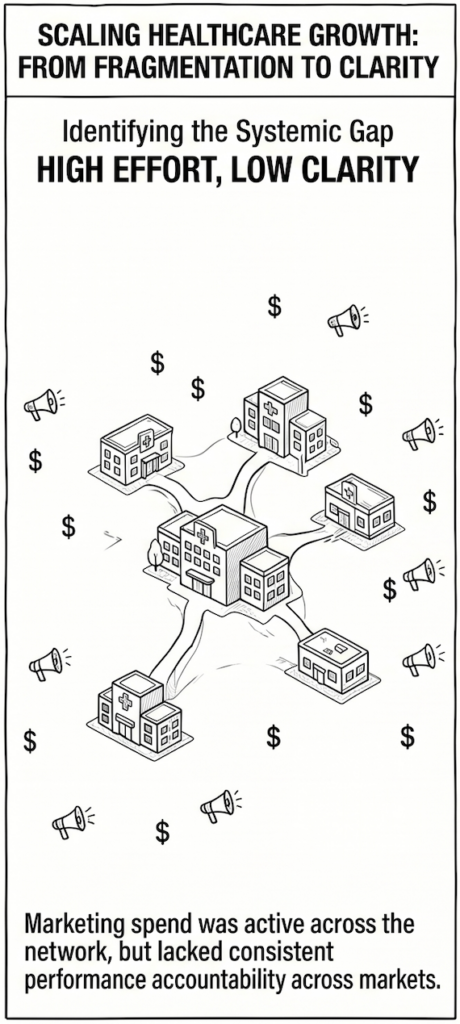 |
When Cimply entered the engagement, marketing activity was already in motion across the clinic network. Media investments extended across multiple local markets, channels, and clinic locations. Reporting existed, but performance visibility remained fragmented and inconsistent. Different markets were being evaluated differently. As a result, leadership could not easily compare performance across regions because reporting standards differed from market to market. As the company expanded, operations gaps created increasing friction in how growth decisions were made. The issue was not effort. Instead, the business lacked a consistent operating framework for healthcare marketing analytics, patient acquisition measurement, and local market investment planning. |
Challenge: Improving Healthcare Marketing Measurement Across Local Markets
At a leadership level, the team needed to answer a deceptively simple question:
Where should we invest to attract the most patients at the lowest cost?”
Answering that question required solving several linked marketing and operating challenges.
Fragmented Performance Visibility
|
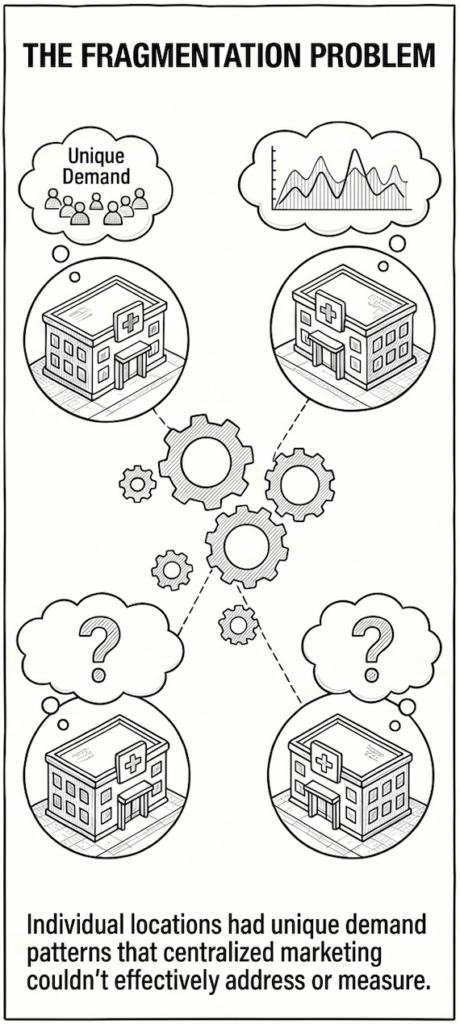
Performance visibility remained fragmented across the clinic network. Although markets behaved differently, the company lacked a consistent way to compare performance. Some regions demonstrated strong patient acquisition efficiency. Meanwhile, others consumed significant media investment with inconsistent outcomes. However, leadership lacked a normalized way to compare clinic-level marketing performance across local markets. Consequently, strategic budget allocation became difficult. Without consistent analytics, investment decisions became more reactive than planned.
|
 |
Incomplete Attribution and Healthcare Marketing Analytics
In addition, healthcare marketing measurement remained incomplete.
Like many healthcare companies, the business faced a disconnect between healthcare advertising activity and confirmed patient visits.
Tracking signals existed, but leadership could not use them consistently.
Marketing teams could see engagement activity. However, business leaders did not fully trust the connection between media spend and patient acquisition.
As a result, uncertainty limited confidence in:
- budget planning
- media optimization
- market expansion decisions
- clinic-level investment prioritization
Centralization vs. Localization
At the same time, the business faced an inherent tension between centralized operations and localized healthcare marketing execution.
Centralized media management created efficiency and consistency. However, localized healthcare marketing created effectiveness.
Localized healthcare marketing improved relevance and effectiveness.
The company needed both.
Patient acquisition plans needed to reflect local conditions, including:
- local market demand
- clinic capacity
- competitive intensity
- regional behavior patterns
- geographic healthcare access realities
At scale, even small inefficiencies became meaningful.
Small budget allocation issues could create significant costs across hundreds of clinics and millions of patient visits.
Ultimately, this was not simply a channel optimization issue.
It was a healthcare growth strategy and operations alignment challenge.
Approach: Building a Healthcare Marketing Measurement Framework
Rather than immediately changing campaigns, Cimply first established a more structured operating framework for healthcare marketing measurement and local market evaluation.
Standardizing Healthcare Marketing Performance Measurement
The first priority was standardization.
Cimply standardized market definitions, clinic reporting, and performance metrics so leadership could evaluate results consistently.
This included:
- aligning market definitions
- improving reporting consistency
- standardizing healthcare marketing analytics
- creating comparable performance benchmarks
- improving visibility into local market dynamics
Once the team established that foundation, clearer performance patterns began to emerge.
Some markets received more investment than demand justified, while others remained under-supported despite demonstrating strong patient acquisition potential.
In many cases, the issue was not the healthcare advertising channel itself. Instead, the problem stemmed from how budgets, expectations, and targeting strategies were applied across fundamentally different local healthcare environments.
Improving Healthcare Marketing Analytics and Attribution
From there, the engagement shifted toward improving healthcare marketing measurement and operations visibility. Perfect attribution in healthcare is rarely achievable. However, functionally useful attribution is.
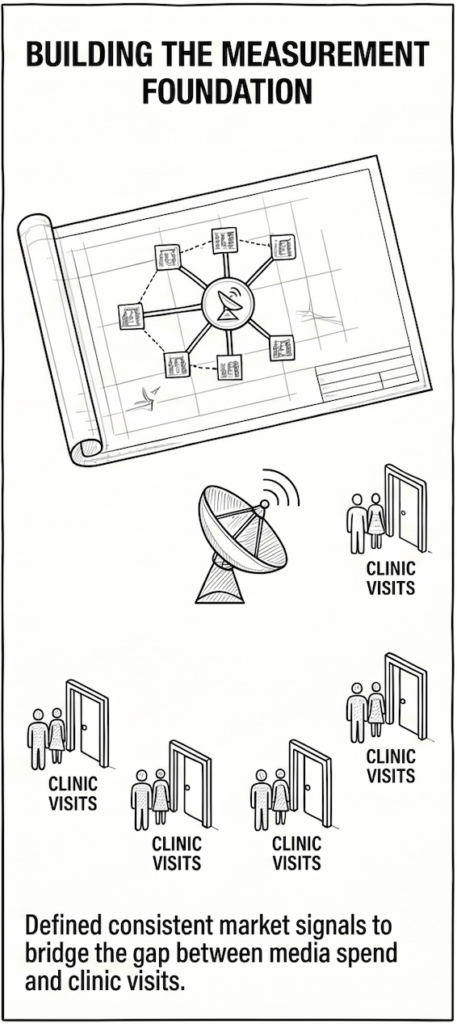 |
Therefore, Cimply aligned marketing signals with patient acquisition outcomes by improving how conversions were tracked and compared across clinics. The objective was not reporting for reporting’s sake. Instead, Cimply focused on creating a shared understanding that both marketing and operations leadership could rely on when making decisions. This included improvements to:
|
Aligning Healthcare Media Investment to Local Market Conditions
Rather than treating every geography the same, instead, healthcare media planning began reflecting the realities of each local market.
|
Investment decisions increasingly accounted for:
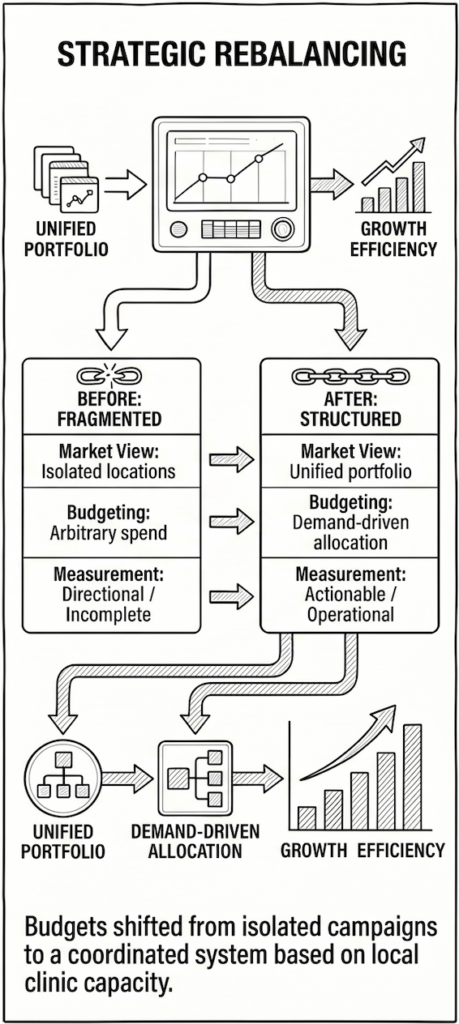
As a result, the team stopped optimizing campaigns one at a time. Instead, it focused on improving performance across the entire network. From there, execution followed the new operations framework. Teams refined campaigns, adjusted targeting, and rebalanced budgets within the context of a broader system designed to improve healthcare marketing performance at scale. |
 |
Outcome: More Efficient Healthcare Marketing and Better Operations Alignment
The most significant outcome of the engagement was clarity.
For the first time, the business gained a clearer view of marketing performance across its clinic network.
As a result, leadership made more informed decisions across both marketing and operations.
Healthcare media investments became more intentional.
Consequently, high-performing markets received increased support, while underperforming regions were evaluated with greater context and a clearer understanding of whether challenges stemmed from:
- market demand
- competitive pressure
- operations constraints
- execution issues
Although healthcare marketing measurement still was not perfect, leadership could now use it more confidently.
Marketing and operations teams began using the same performance signals. This improved alignment and reduced internal friction.
From a business standpoint, the engagement contributed to:
- more efficient healthcare media spend
- improved market-level visibility
- stronger budget allocation discipline
- more scalable patient acquisition planning
- more confidence in local growth choices
More importantly, the company evolved from managing disconnected campaigns into operating a more coordinated healthcare marketing system.
Once that operations framework was in place, the company could scale future healthcare growth initiatives with significantly greater confidence.
Closing Perspective: Why Healthcare Marketing Measurement Matters
Distributed healthcare companies introduce a unique marketing challenge.
The challenge is not managing a single audience or a single market.
Instead, they manage many local healthcare markets. Each market has different patient behavior, competition, and operating conditions. At the same time, leadership remains accountable for overall business results.
However, that requires more than execution alone.
It requires structure, operations alignment, and consistent healthcare marketing measurement.
This engagement reinforced a simple but important principle; healthcare marketing performance improves when three things work together:
- how markets are defined
- how performance is measured
- how investment decisions are made
When those elements align, healthcare marketing becomes:
- more measurable
- more efficient
- easier to scale
- easier to defend from both a financial and operating view
Ultimately, growth at scale is not about doing more everywhere.
It is about understanding where to invest, what levers to pull, and why.