

Overview
Launching a premium, membership-based healthcare platform with a large dataset of prospective customers already in hand seemed like it would be easy, but the brand lacked a reliable way to determine which records were usable, which prospects were most valuable, and how the data could support more precise marketing activation. What made the business challenge unique is that this healthcare startup was seeking it’s foundational membership by asking for a 3 year committment up front to the tune of $300,000, which they had translated to a stated goal of engaging the “top 1% of the file with a net worth greater than $30,000,000”.
Cimply was engaged to turn that fragmented data environment into a structured customer intelligence foundation. The work included first-party data assessment, identity standardization, multi-source enrichment, signal validation, segmentation, scoring, and activation planning.
The result was not simply a cleaner dataset. It was a prioritized customer intelligence framework designed to help the organization make better decisions about which prospects to target, where to prioritize and focus investment, and how to prepare its CRM and marketing workflows for future activation.
At a Glance
Client Type: Premium membership-based healthcare platform
Challenge: Large prospect dataset lacked structure, validation, and prioritization
Starting Point: Approximately 57,875 prospect records
Qualified Working File: Approximately 39,176 U.S.-based records
Cimply Role: Data readiness, enrichment orchestration, segmentation, scoring, and activation planning
Outcome: Prioritized customer intelligence framework for more confident marketing execution
The Business Challenge: Data Volume Without Marketing Readiness
Originating from the billionaire-founder’s personal rolodex, the healthcare brand possessed a large volume of prospective customer data collected across multiple sources and years of business activity. At first glance, the data appeared viable and valuable. But in practice, the data lacked the structure, validation, and intelligence required to support confident business or marketing decisions.
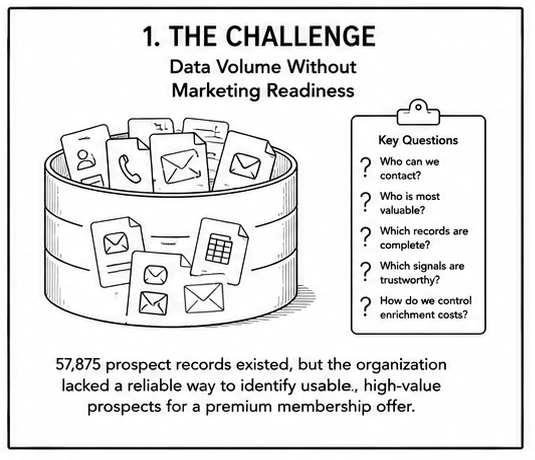
Given the size and age of this first party consumer data, the brand needed to answer several practical questions before any acquisition and lifecycle marketing efforts could scale effectively:
- Who can we legitimately contact without running afoul of privacy law?
- Which prospects are most commercially valuable?
- How many records are complete and accurate enough to operationalize?
- Which third party data providers could produce useful and trustworthy signals?
- How would data enrichment costs be controlled while maximizing usable output?
- Can multiple enrichment layers be validated against one another?
Messy data was the least problematic issue. The larger risk was that future marketing investment would be guided by incomplete, inconsistent, or low-confidence customer signals. Without a reliable segmentation and prioritization model, the organization risked spending against volume rather than value.
What we had was customer data, but it lacked customer intelligence.
Why the Data Was More Complex Than a Standard CRM Export
An additional layer of complexity emerged during the assessment process. The dataset had accumulated organically over decades through founder relationships, referrals, events, professional networks, business activities, and historical outreach.
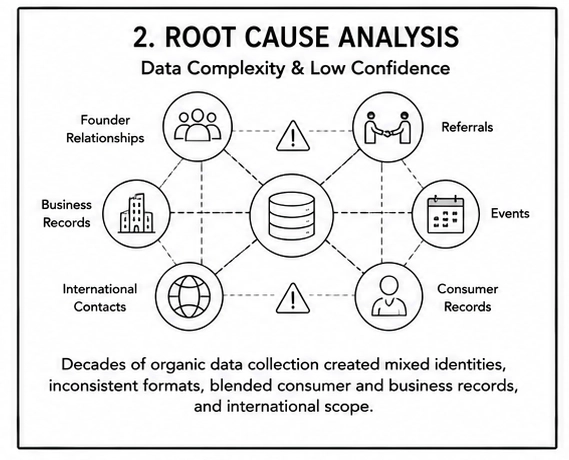
Understanding data provenance is a key factor in how it can be used in the future. This was not a traditionally governed CRM dataset created through a single acquisition source or structured lead-generation program. Some records represented long-standing personal or professional relationships. Others were minimally qualified contacts with limited documented history. Consumer and business interactions were also blended together, creating additional identity and segmentation complexity. Not to mention this mixture of records was from more than a dozen countries.
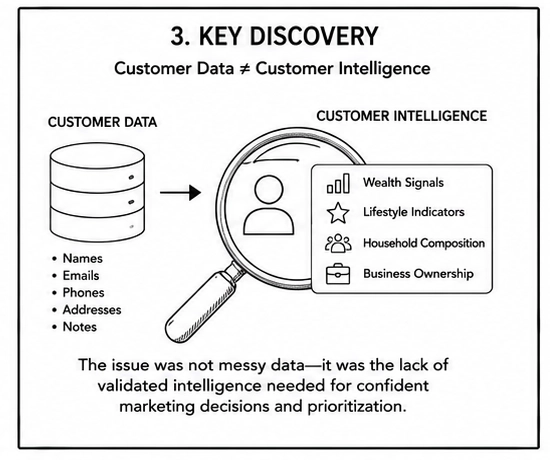
That history made the dataset potentially valuable, but difficult to interpret. Cimply needed to preserve the potential value of the relationship history while creating a structure that could support responsible segmentation, enrichment, and marketing activation.
Cimply’s Approach: Data Readiness Before Enrichment
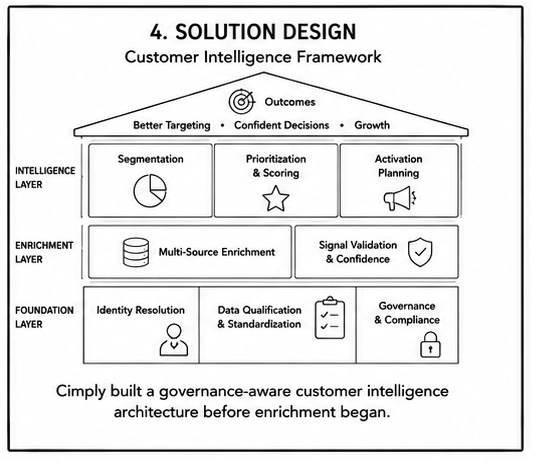
Rather than enriching the entire file immediately, Cimply first assessed whether the records were structurally usable, in scope, and appropriate for enrichment. The review identified mixed consumer and business identifiers, inconsistent phone and email formats, partially populated addresses, improperly parsed fields, and international records embedded within a primarily U.S.-focused growth strategy.
Cimply treated the engagement as a customer intelligence strategy, not a commodity data append project.
This initial assessment focused on five areas:
- File structure and schema consistency
- Identity standardization across names, phones, emails, and addresses
- Domestic versus international record handling
- Consumer and business identity interpretation
- Readiness for enrichment, segmentation, and CRM activation
Because global privacy and consumer data regulations vary by jurisdiction, Cimply separated non-U.S. records into a future-state governance workflow rather than processing them through the primary U.S.-focused enrichment model.
The objective was not to maximize record volume. The objective was to maximize operationally usable customer intelligence while reducing legal risk, enrichment waste and improving overall confidence in downstream decisions.
Data Qualification and Standardization
Once the high-confidence U.S.-based data was isolated, Cimply restructured and standardized the underlying file architecture to improve enrichment performance.
This included correction of field parsing inconsistencies, normalizing phone and email structures, validating postal information, separating out-of-scope records, and preparing the file for provider-specific matching workflows.
Qualification Waterfall
| Dataset Stage | Approximate Record Count | Strategic Purpose |
| Initial source dataset | ~57,875 records | Starting point representing accumulated prospect and relationship history |
| Qualified and prepared U.S.-based records | ~39,176 records | Reduced noise, improved structure, and established an enrichment-ready working file |
| Progressively refined matchable subsets | Variable by provider and enrichment layer | Optimized provider-specific matching and downstream segmentation confidence |
This reduction was intentional. Improving the quality and structure of the input data increased match confidence, enrichment efficiency, segmentation reliability, and downstream marketing usability.
Multi-Source Enrichment Orchestration
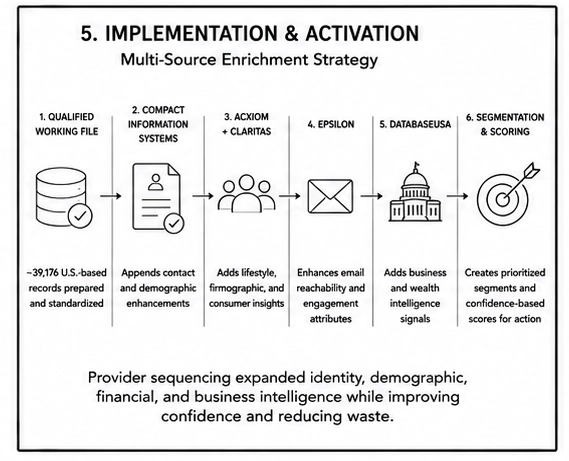
Cimply designed a staged enrichment model rather than sending the full file indiscriminately through multiple providers. Each provider was used for a specific role in the customer intelligence architecture.
Provider Sequencing Methodology
| Provider Layer | Strategic Purpose |
| Compact Information Systems | Established the foundational identity layer and core demographic structure |
| Acxiom + Claritas | Expanded financial, wealth, and income-producing asset visibility for segmentation modeling |
| Epsilon | Added demographic depth and tertiary validation signals |
| DatabaseUSA | Added business ownership and firmographic intelligence for higher-value prospect identification |
This sequencing strategy helped Cimply use each provider for its relative strengths while minimizing unnecessary processing costs and duplicate signal inflation. It also allowed overlapping attributes to be compared across providers, creating stronger confidence in the final segmentation framework.
Rather than relying on a single provider’s interpretation of customer value, the engagement used multiple enrichment perspectives to build a more durable and operationally trustworthy customer intelligence model.
Identity Resolution and Signal Expansion
The source dataset was primarily populated with various combinations of names, phone numbers, email addresses, and partial postal information. The records included consumer email domains, corporate domains, mobile phone numbers, residential and business landlines, and non-standardized addresses.
Despite those limitations, the staged enrichment process materially expanded the organization’s visibility into customer identity, demographics, financial capacity, household characteristics, lifestyle indicators, behavioral patterns, and business ownership signals.
Identity and Demographic Match Performance
| Match Category | Outcome |
| Name and address coverage | Approximately 53% coverage after address standardization and identity expansion |
| Demographic enrichment | Approximately 63% to 72% coverage across providers |
| Business and firmographic matching | More than 19% coverage tied to business ownership and organizational attributes |
| Income-producing asset visibility | Approximately 63% coverage |
| Net worth indicators | Coverage ranged from approximately 13% to nearly 63% depending on provider methodology |
These results were important because not all data is equally matchable. When structured properly, even partial coverage can become highly actionable.
Most importantly, overlapping signals across providers created opportunities for weighted scoring, normalization analysis, and confidence-based prioritization. Cimply did not treat all appended values equally. The work evaluated where providers aligned, where they diverged, and how those patterns should influence segmentation confidence.
Customer Profiling and Segmentation Framework
Once enrichment was complete, the dataset evolved from a flat collection of records into a multidimensional customer intelligence environment.
Cimply developed a segmentation framework across five primary dimensions:
| Segmentation Dimension | Strategic Objective |
| Customer value tier | Prioritize likely high-value prospects |
| Financial capacity and liquidity | Align outreach with economic potential |
| Lifestyle and affinity indicators | Improve customer fit and messaging relevance |
| Household composition | Support demographic and lifecycle targeting |
| Life stage | Improve contextual segmentation relevance |
The segmentation model was designed to help the organization make practical marketing decisions: which prospects to prioritize, which markets to emphasize, which audience groups required different messaging, and which records deserved higher confidence in activation.
Each record was then scored using a weighted prioritization methodology. This allowed the organization to distinguish high-value prospects from lower-priority contacts, relationship-rich records from low-confidence identities, and strategically aligned audiences from lower-fit segments.
Key Strategic Insights
With structured and enriched customer intelligence in place, the organization uncovered several meaningful audience patterns.
| Key Finding | Business Implication |
| High-value prospects concentrated within specific geographic markets | Improved future regional targeting and market prioritization opportunities |
| Financial capacity correlated strongly with engagement likelihood | Supported more efficient audience prioritization and investment planning |
| Lifestyle indicators aligned closely with product fit | Improved future messaging and targeting relevance |
| Household composition patterns emerged across top-value segments | Supported lifecycle segmentation and more nuanced audience planning |
| Business ownership indicators surfaced among priority segments | Created additional partnership and relationship development opportunities |
These insights replaced broad assumptions with data-supported audience patterns that could inform regional targeting, messaging strategy, prioritization, and future CRM activation.
From Customer Intelligence to Marketing Activation
The engagement was not designed to end with enrichment and segmentation alone. A core objective was ensuring that the resulting customer intelligence framework could be operationalized within the organization’s future marketing workflows and CRM infrastructure.
Cimply provided the organization with standardized data structures, prioritized audience segmentation models, confidence-based scoring methodologies, enrichment architecture documentation, and future-state activation recommendations.
Because the organization intended to operationalize the segmentation strategy in HubSpot, Cimply also helped evaluate and select the implementation partner for the next phase. This ensured that the customer intelligence framework could move from analysis into CRM structure, marketing automation, segmentation deployment, and repeatable campaign execution.
The project therefore evolved beyond a traditional enrichment exercise into a broader customer intelligence enablement initiative designed to support scalable segmentation, audience prioritization, CRM operationalization, and more precise lifecycle engagement.
Business Outcomes and Marketing Impact
By the conclusion of the engagement, the organization had transformed a fragmented and inconsistent prospect dataset into a prioritized customer intelligence asset capable of supporting more precise marketing and growth decisions.
Data Outcomes
• Reduced the dataset from approximately 57,875 records to approximately 39,176 qualified U.S.-based records
• Improved data structure, identity normalization, and enrichment readiness
• Established a governance-aware approach for domestic and international record handling
• Created a multi-provider enrichment architecture with clearer signal confidence
Marketing Operations Outcomes
• Developed a repeatable enrichment and segmentation process
• Created prioritized audience segments tied to customer value, fit, and confidence
• Improved future CRM and marketing automation usability
• Supported more focused targeting and lifecycle planning
Business Decision Outcomes
• Improved visibility into prospect value and audience composition
• Reduced uncertainty in future campaign planning and audience activation
• Supported more efficient allocation of marketing investment
• Shifted the organization from broad, volume-driven prospecting toward intelligence-driven marketing execution to the segments comprised of the top 500 members of the database.
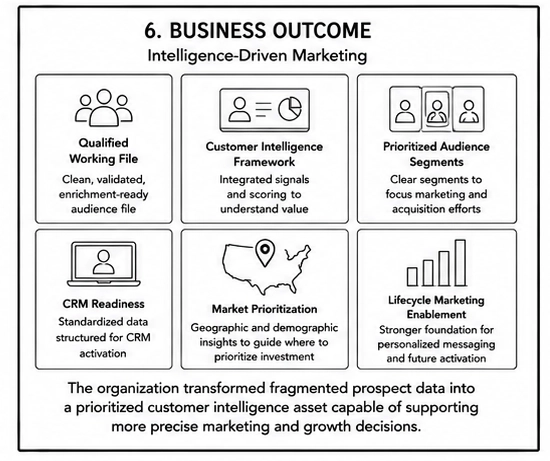
The engagement did not create value simply by adding more data. It created value by making the data more usable, more interpretable, and more operationally relevant.
Why This Case Study Matters
Large datasets often create the illusion of marketing readiness. Without structure, validation, governance, and prioritization, those datasets can limit performance rather than improve it.
This engagement showed why readiness has to be earned before activation can scale. Better inputs produce stronger match rates. Stronger match rates improve segmentation confidence. Better segmentation supports more focused targeting, better resource allocation, and more accountable marketing execution.
Better marketing does not start with more spend or more data. It starts with better customer intelligence.
When customer data is structured, standardized, enriched, validated, prioritized, and operationalized, marketing teams can make better decisions about who to target, where to invest, and how to activate with confidence.
The result is marketing that becomes more precise, more efficient, more accountable, and more strategically aligned to customer value.