

This publicly-traded holding company was formed and purpose-built with the promise of modernizing the home buying process by providing proprietary technology and products to the network of real estate Brands they operate. The stock however has steadily declined over the past decade, and is lower now than ever before.
The Enterprise Chief Marketing Officer was leading multiple initiatives aimed at enabling the disparate operating Brands to uniquely address their respective markets while consistently providing the right data to Enterprise stakeholders that include the Chief Operating Officer, Chief Financial Officer, and the Chief Strategy Officer. Greater transparency and access to the right data will support strategic planning and decision making at the highest-level of the Enterprise while also empowering the Chief Executive Officer to better contextualize the company’s performance and actions to the street.
ENTERPRISE MARKETING DATA CHALLENGES
The ability of the Enterprise Chief Marketing Officer to answer key questions from the C-suite is hampered by a lack of a single and centralized view into the planned and actualized financial data and marketing performance across the multiple Brands. The CMO Council is the primary vehicle of influence for the Enterprise CMO as the others do not directly report at the Enterprise-level. The CMO Council includes the five (5) Chief Marketing Officers that manage the seven (7) distinct Brands in the marketplace along with other key executives from the business. As expected, each Brand has their own teams and financial systems, and utilize a variety of software tools, platforms, and service providers to support different aspects of marketing campaigns and initiatives.
GOALS FOR MARKETING AND FINANCE ALIGNMENT
The Enterprise was actively running a number of projects related to increasing investment in digital as a percentage of spend, improving budgetary controls, and examination of return on investment. The goal was ultimately an integrated Planning, Buying, and Reporting framework that would connect the marketing data ecosystem end-to-end. This enables the use of financial inputs as the foundation to facilitate the measurement of the economic performance of marketing spend. This would allow the Brand-level Chief Marketing Officers to run their businesses more effectively and efficiently while still meeting the data transparency and governance needs of the Enterprise. The Enterprise wants to to make data-based decisions to fuel growth by analyzing marketing investments in pursuit of spend optimization goals across paid, owned, and earned media.
OUR APPROACH TO STANDARDIZING MARKETING AND FINANCIAL DATA
Cimply was initially engaged to assess the digital marketing capabilities of this multi-Brand enterprise. The assessment was to focus on ensuring that the Enterprise and its operating Brands had the necessary capabilities to continue executing existing advertising and marketing plans while rationalizing, consolidating, and ultimately centralizing much of their digital marketing infrastructure and services delivery. Very quickly it became clear that there were distinct turf boundaries and limitations on how much access we would be provided within the operating Brands. This ultimately led to a change in tack and the planned assessment evolved into the development of a Modern Marketing Excellence Guidebook.
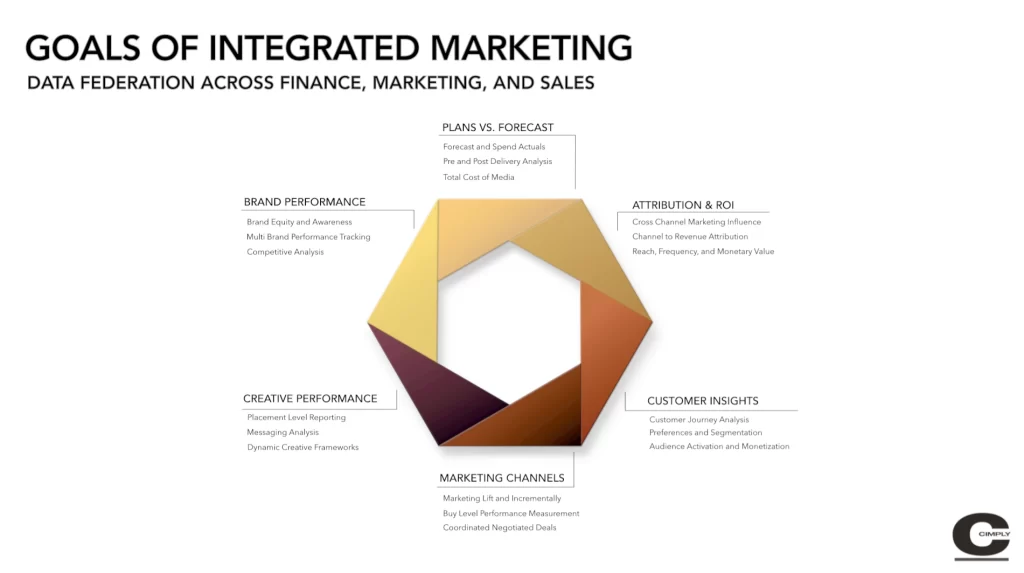
The Enterprise CMO leveraged the Modern Marketing Excellence Guidebook in leadership of the CMO Council to lay the groundwork for a vision of increased collaboration between the Enterprise and the operating Brands. The client recognized that a comprehensive Marketing Center of Excellence would serve as the vehicle to drive this vision, aligning diverse teams and Brands under a common set of parameters while nurturing individual creativity and independence.
Setting the stage, this guidebook embodied the vision of Best-in-Class Marketing, specifically in a House of Brands, where success is anchored in measurability, integration, and attribution. In the book we outlined five (5) key pillars that shape the foundation of marketing excellence:
- Connected Customer Strategy: cultivate long-lasting relationships and transform buyers into brand advocates
- Data Strategy: make informed decisions, optimize campaigns, and seize opportunities with precision and foresight
- Analytics (Customer, Audience, Content, Campaign, Business): gain deep insights into customer behavior, content performance, and campaign efficacy
- Omni-channel Activation: create a compelling journey that resonates with the audience
- Measurement: provide clarity on ROI, enable data-backed decision-making, and fuel innovation as we chart the path forward.
In this case, getting to readiness through Marketing Governance would be the common theme through more effective Data Strategy, Analytics, and Measurement.
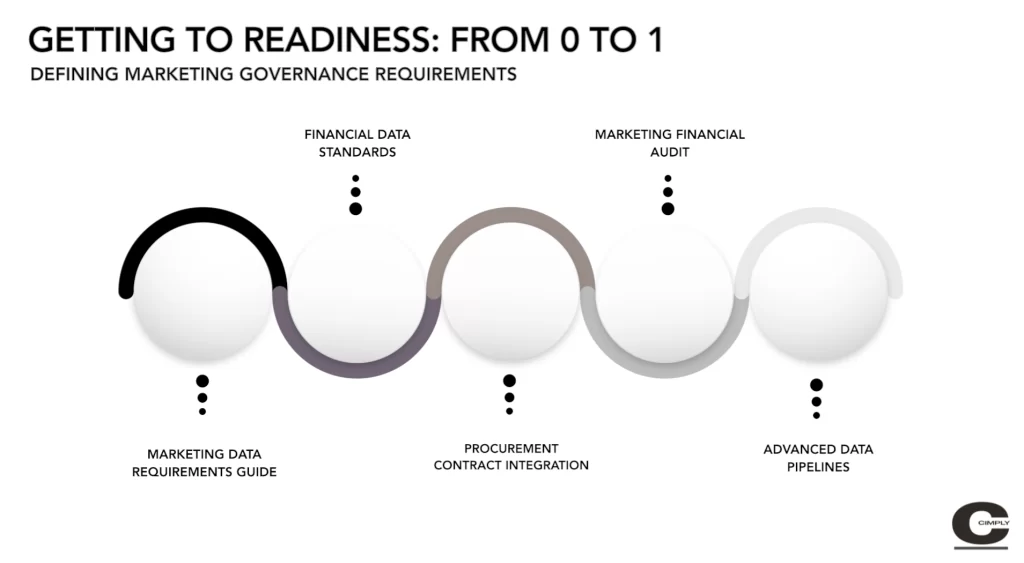
The Marketing Data Requirements Guide was developed in collaboration with the CMO Council, Procurement, Finance, and Legal for use by the Brand teams directly or through collaboration with Agency and Platform partners.
This Marketing Data Requirements Guide contains 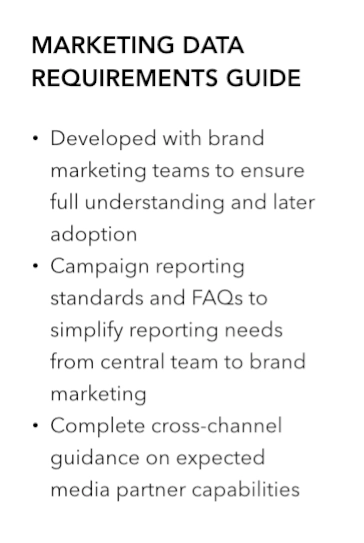 detailed data output file contents and configuration requirements related to the planning, activating, and performance reporting of Social, Search, Lead Generation Affiliates, Video, Audio, Out of Home, Digital Out of Home, Direct Mail, Print, and Email. There are also instructions related to the Administration and Ownership of third party platform accounts, Data Output and Delivery Requirements, Tagging and Tracking of campaigns, and Historical Lookback Windows. This is all aimed at establishing standard and reliable data pipelines for analysis while also securing primary access and control of all Brand platform accounts from any partner agencies.
The channel-level Data Requirements Template(s) within the guide set the standard for expectations on detailed media reporting and attribution. This framework has been structured based on media buying best-practices and would be compatible with any sophisticated agency buying practices that the operating Brands may encounter. The design naturally rolls up to funding sources and will provide flexibility of reporting at the most granular levels.
The second half of our data initiative focused on financial data. We partnered closely with Finance and Procurement to tackle a fundamental challenge. The enterprise was using multiple financial management systems, which made it difficult to track marketing spend accurately and nearly impossible to connect that spend to business performance. Budgeting had become a manual, fragmented task, and reporting lacked the consistency needed for confident decision-making.
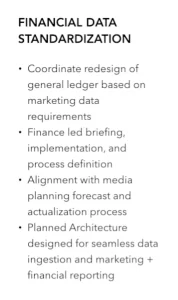
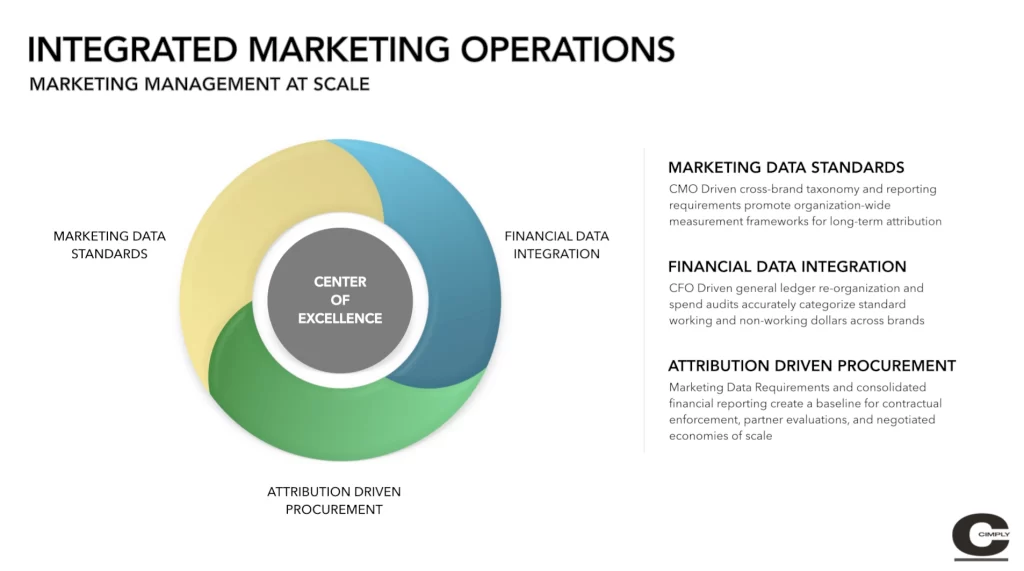
To solve this, we launched a Financial Data Standardization effort grounded in the company’s core business structure. By aligning marketing-related data directly to the General Ledger, we enabled a much clearer view of how marketing investments relate to forecasts and actuals. This change made it significantly easier for both Finance and Marketing to track expenditures, review performance, and update forecasts with confidence. This in effect closes the loop with the Marketing Data Requirements as they were formally adopted and integrated into the Enterprise Procurement and Data Governance policies.
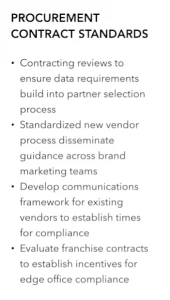
From this point forward, any marketing supplier contracts will include these Data Requirements as part of the standard data sharing agreement terms. An effort was underway to identify those that recently signed or renewed for amendment of the agreements.

 To support the rollout, we introduced a Budget Reporting Template that builds directly on the Enterprise’s existing budget process. The template saves time by keeping familiar workflows intact, while also introducing a cleaner, more structured way to request and report budget details. We paired this template with a simplified General Ledger structure, helping stakeholders understand where dollars are going, how they relate to key marketing channels, and how they map to overall business objectives. Brand teams often submit budgets with limited detail about channel allocations. Our structure accommodates this by allowing more granularity to be added later, once media plans are finalized. This flexibility supports both top-down planning and bottom-up updates as campaigns evolve. The end result is more accurate projections and a faster, more transparent reporting process. Within the Enterprise Procurement platform there are commodity codes which further sub-categorize products and services in the Enterprise financial system and will be incorporated into later exercises to report on Strategic Planning Budgets across the organization.
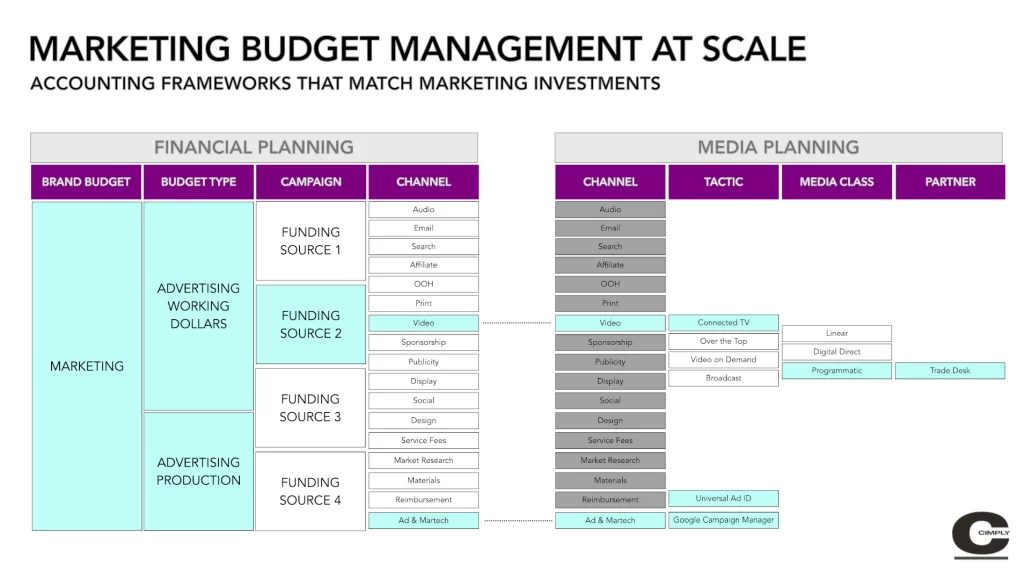
With this work complete, the data now flows through a fully aligned system. The General Ledger framework matches exactly with the Budget Reporting Template and the Data Requirements Template.
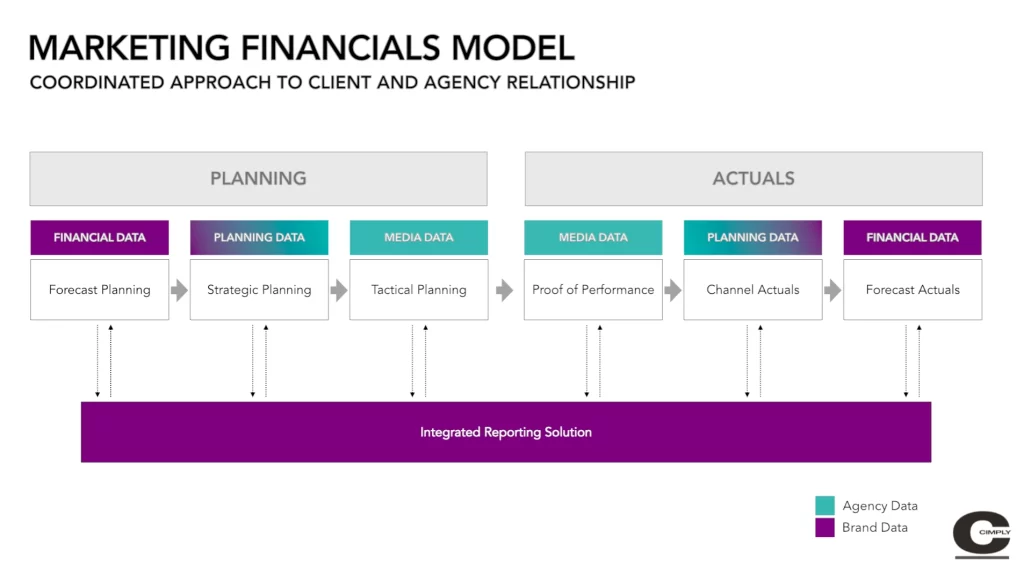
This alignment removes ambiguity and eliminates the need for manual interpretation between financial reports and marketing inputs.
RESULTS OF THE MARKETING AND FINANCE INTEGRATION
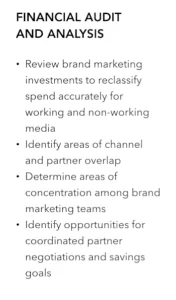
The initiative delivered measurable improvements in financial transparency, operational efficiency, and marketing accountability by aligning financial and marketing data at the source and standardizing key processes. The Financial Audit and Analysis revealed that over 75% of the company’s stated $250 Million annual marketing spend was not tied to working media or what most would consider “marketing”, but to sales enablement, operations, brokerages, tech, and franchise-related activities. McKinsey, brought in after this engagement, endorsed these findings, unable to further clarify or add value to the understanding of the marketing budget, validating the project’s clarity and impact.
Other notable outcomes included:
- Eliminated Redundancies: Mapped areas of channel and partner overlap, enabling more informed decisions on media mix and partnership strategy.
- Vendor Rationalization: Uncovered opportunities for vendor consolidation, reducing administrative burden and improving negotiating leverage.
- Accurate Financial Classification: Reclassified brand marketing spend using standardized definitions of working vs. non-working media, enabling better budget allocation and performance tracking.
- Cross-Team Visibility: Exposed areas of spend concentration and functional overlap across brand marketing teams, providing leadership with clearer insight into resource distribution and collaboration gaps.
- Finance-Marketing Alignment: Enabled a closed-loop system between finance and marketing, supporting more accurate forecasting, budgeting, and compliance through hardened data pipelines and audit-ready standards.
CLIENT FEEDBACK AND RESULTS
“Cimply helped navigate technical and data driven challenges masterfully. Their ability to traverse and partner with leadership across marketing, finance and IT disciplines are welcome in an ever changing and complex ecosystem that data driven professionals are navigating. Cimply is a sounding board that reminds leaders and professionals to take a step back and look at things simply and logically.”
P.D., Senior Director, Enterprise Marketing Performance and Analytics
“Cimply had great expertise and brought very innovative ideas to the table. I appreciated the way their minds worked and the knowledge that they would embed in their solutions and suggestions”
A.W., Manager, Performance Marketing and Analytics
”The Cimply team consistently provides strategic knowledge that helps shape our charters path. Their voice and industry expertise is a welcomed addition to our team.”
B.H., Director of Performance Marketing
“Cimply was extremely useful and brought up unique points of view in nearly all situations. They remained focused on what was critical and always ensured that we had what we needed to succeed.”
K.R., Manager, Analytics and Measurement