

We were recently invited to pitch for a media agency-of-record assignment. On paper, it was a classic brief: Define the channels. Build the plan. Show how you’d spend the budget to drive growth. We were up against two much larger media agencies. One was a publicly traded programmatic and data firm, the other a bi-coastal shop with a large team of cross-channel media buyers.
As you would expect, both answered the brief mostly to the letter. Hammer, meet nail. You say “media”, they say “how much”? We did not. First, we told the client we reframed their brief. Next, we told them they weren’t ready to invest heavily in paid media. Then we showed them every pain point they should address before investing in marketing. Only then, and when pressed, did we come back with a high-level channel recommendation.
What we presented was not a show-and-tell or a credential parade. It was a thoughtful outline of deliberate actions and activities the Brand must prioritize to establish a foundation to turn media investment into actual business growth.
There were a number of areas that made it clear that product-market-fit was not there. They were targeting “small businesses”, the quicksand of every enterprise growth initiative. Even if they found product market fit, they had not addressed the core capabilities to onboard, support, and retain customers. This isn’t a knock on them. It is a strategy challenge facing most businesses that are expanding fast or operating in noisy, competitive markets. There’s urgency to do something, anything, to get attention and acquire customers, and media feels like the natural next step. But as is often the case, churn was a key issue that needed fixing before acquiring more customers.
That urgency to “sell more” can be expensive if it’s not grounded in a clear understanding of the customer, the product, and the market. Too many growth plans skip straight to tactics. They jump into buying media, activating channels, and building out creative assets. But without the fundamentals in place, those efforts fail, and fast.
That’s the pattern we were aiming to break: tell the client what needs done so their media cost would instead become a media investment. So rather than start with a media plan we walked through the 25 points they needed to sort out before they could consider investing more in paid media.
In the end, we didn’t get the media business. No one did. The client decided to go back to the drawing board and re-assess their goals, objectives, and in some ways the product itself. We saved them millions with an hour of content and a thoughtful approach to their business. But this is where so many businesses often fail.
The Real Reason Business Growth Plans Stall (It’s Not always Marketing Tactics)
Campaigns aimed at growth don’t fail because the channels were wrong or the creative wasn’t punchy enough. Those things can be analyzed and optimized. Growth fails to happen because the business hasn’t put in the work to understand the customer, the market, or their own position within it before taking action.
It fails when:
- The ICP hasn’t been validated
- The segmentation is too shallow or too broad
- The funnel is generic
- The onboarding experience is clunky
- The customer churns and no one knows why
In fast-moving companies, it’s easy to jump ahead. You get pressure to scale. You want to catch up to competitors. You see someone else’s campaign and think, “We need to be in the market with something too.” But moving fast without a foundation in place is not a strategy. It’s hope. And hope, while useful in life, is not a reliable growth plan.
Media Readiness Checklist: What To Fix Before You Spend on Paid Channels
In our pitch, we outlined 25 areas that needed to be addressed before serious media dollars should be deployed.
These included things like:
- Clarifying what defines product-market fit
- Identifying success patterns within the current customer base
- Building meaningful, segment-specific messaging
- Improving data infrastructure and reporting
- Strengthening onboarding to reduce early churn
- Developing a customer-centric content strategy
- Defining pricing strategy across segments
- Establishing a feedback loop between marketing and customer success
We didn’t give them a roadmap. We didn’t pretend to have all the answers. We simply pointed out the things that needed to be done before the media would help, and not hurt, their growth.
That’s what readiness looks like. Not perfection. Just alignment and clarity around the fundamentals of committing to starting with your customers.
Customer Centric Growth: What We Mean by “Start with the Customer”
Starting with the customer isn’t just about saying the word “customer” a lot. This will obviously vary based on the industry, category, or type of business, but it’s about building a clear, specific, validated understanding of:
- Who your best customers are
- What problems they are solving
- Why they buy from you
- What makes them stay or leave
- What behaviors they show during research, trial, conversion, and retention
You can’t get all of that perspective from a single data source, so you have to triangulate with multiple types of data. That might include:
- First-Party Data: This is any data you have collected or created in your relationship with prospects and customers and might be in your CRM, Accounting, Shipping, or other ERP type of systems (or a spreadsheet), and any of your website or app event tags or tracking instrumentation deployed to observe and capture pre- and post-purchase behaviors, on-site or in-app behaviors, and any chat or support interactions.
- Third-Party Data: This could be public record, census, open, and other commercially available data sources of consumers and businesses, at an individual level or in aggregate, containing detailed demographic and socio-economic data, firmographic and technographic data, and market-level data that is either actual, self-reported, or modeled. This data can be licensed and used to enrich your customer data to provide a deeper and more colorful understanding of who they are beyond the transaction profile that you see. Choosing the right partner here is critical as the data market in the U.S. is somewhat self-regulated for most data types.
- Primary Research: This is the not-so-secret weapon of great products and services. Plan and be deliberate about talking to your customers and collecting feedback through customer interviews, periodic surveys, observational studies, and then to flip the script, you should also conduct ‘secret shopping’ at your own business on a regular basis to fully experience what the customer experiences.
- Secondary Research: There should be an ongoing effort to compile and track any relevant industry, government, and academic papers or research, PR and trade commentary on the competitive set, to include trade analyst rankings and reviews, overall market segment trend analysis, and even pricing or geographic comparisons where applicable.
This doesn’t mean you need to conduct a six-month ethnographic study and hire a team of economists and data scientists. But you do need to commit to learning and not guessing about who your best customers are and what they need from you.
Turn Insights into Growth: A Customer Value Framework
Understanding the descriptive and behavioral traits to prioritize, lets us use simple frameworks to turn insight into action and determine who are our best fit prospects. We knew the client needed to better understand their customers to determine who to target in the future. One of a our favorite tools to reach for is the 2×2 box:
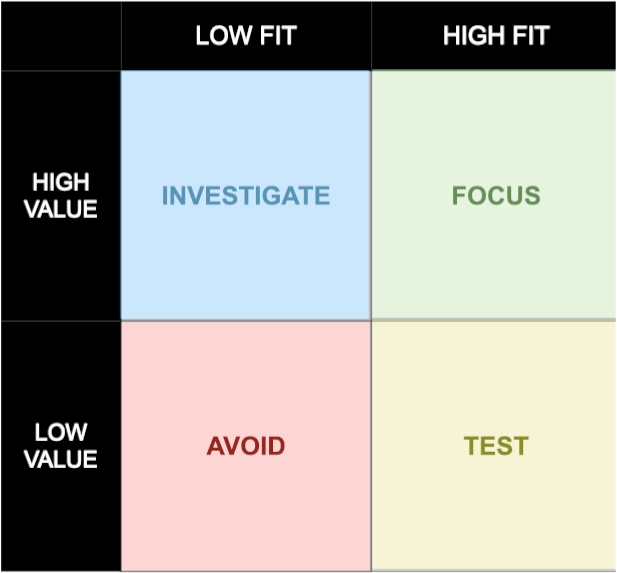
X-axis: How closely does the Customer Fit the descriptive and behavioral profile of your validated ICP or “best” customers?
Y-axis: What is the Value exchange placed on the solution? This can be pricing, margin, criticality or importance.
This lets us sort the universe into four basic quadrants:
High Fit / High Value = Focus
These are customers that love our product and we love them. They Advocate for our Brand and they seek out new ways to engage with us. They always choose us based on trust.
High Fit / Low Value = Test
These are customers that like our product but don’t buy as frequently. They choose us, but maybe not all the time or they always use a coupon or buy less from us when they do. For one reason or another we are just not always top of mind or they have specific needs we do not meet.
Low Fit / High Value = Investigate
These are customers that buy a lot from us but something just doesn’t fit. Maybe they spend with us but always complain. Maybe they have frequent returns and exchanges or they always need high touch support.
Low Fit / Low Value = Avoid
These are customers that complain and don’t spend. They take up time and energy but don’t add value to the business. They take up resources and never seem happy. They require additional support, have budget or price sensitivities, are out of the trade area, and if they don’t churn, will be a drag on profitability. Any effort here to suppress response and engagement from this segment is rewarded handsomely.
You can make this as sophisticated as you need, but the value is in the clarity it creates. I encourage you to experiment with different Low/High concepts. In our pitch, we used the Value axis as Customer Lifetime Value (CLV) of their end customer, and since they were a Business to Business (B2B) product, we encouraged our client to think of the value of each Ideal Customer Profile (ICP) segment independently. If the product had customers in 4 industries, when combined with a 2×2 you would now have 16 segments to consider. The value of a Plumber’s customer is likely different than that of an Accountant, a Dentist, or an Auto Mechanic.
There are other simple tools that can be used to frame your thinking, but building a 2×2 can be a very powerful forcing mechanism. Once you can organize your customer understanding you can stop thinking about media as something you do to “get more leads” and start thinking about it as something you do to find the people who want to use your product.
Why Customer Behaviors Beat Demographics in Modern Marketing
In general these principles apply whether you sell to consumers or businesses, and whether you’re selling a product or a service. Here is a business-to-business scenario we see often. Armed with a dearth of descriptive data, it’s easy to get excited about colorful slides filled with job titles and business characteristics, laced with quotes from real customers and backed by interviews and survey data. It feels like progress. But this static profile is only one side of the coin. The real insight comes from examining customer behaviors. Actions speak louder than words.
We look at things like:
- How people navigate the website or app
- How quickly they convert
- What paths do successful customers take
- What behaviors are correlated with churn
- What actions correlate with retention and expansion
When we overlap these behavioral insights with the descriptive data, that’s when we start to see the shape of a real persona. If you’re selling sunglasses, its more than just “Male, 45-50, Outdoors Interest” but a “Boat Owner, Family Man, who likes to Fish, that lands on a product page first via a search, and re-visits the site directly 2+ times, viewing products in 2+ categories, and once items are in cart (enough for free shipping) checks out in under five minutes.”
Another potential facet of the behavioral taxonomy if your business is recurring or transactional in nature would include things like:
- Recency: When was the last time they purchased?
- Frequency: How often do they purchase?
- Monetary: How much do they spend?
Building rich descriptive profiles, detailed behavioral profiles, then overlapping them will magically surface the customer we want to clone. And that’s someone worth building a media strategy around.
How to Build Growth Foundations Fast Without Slowing Down Your Go-to-Market
This kind of foundational work doesn’t need to take six months. It can be done quickly, incrementally, and with high impact. But skipping it guarantees you’ll waste time, money, and credibility when the media doesn’t deliver what you hoped it would. Media is expensive. But misalignment is even more costly.
Why Great Agencies Challenge the Brief …And Why Brands Should Welcome It
When we tell this story, the most common question we get is: why would you push back on the brief? Because doing the right thing means not giving the client what they asked for, but telling them what they need to hear. The worst thing we could do is to build a media plan on top of a shaky foundation. That’s not a partnership, it’s sales for the sake of revenue.
Media, at its best, is an amplifier, but what it amplifies depends on what’s already there. If you’re unclear on your product-market fit, targeting the wrong segment, using the wrong message, or selling a product that only converts and doesn’t retain, media will simply make the problem louder and more expensive.
Our job isn’t to drive impressions, it’s to drive outcomes; and that starts with readiness.
Next Steps: Building Your Growth Readiness, One Block at a Time
Over the next several months, we’ll be unpacking these 25 areas in more detail. These will be short and focused posts, each one highlighting a single building block that businesses can use to get incrementally closer to growth readiness. They’re not meant to slow you down. They’re designed to make sure you’re pointed in the right direction. Customer-First Growth: Long-Term Success Starts With the Right Foundation
We didn’t win the media contract, but we won the client. We may have saved them millions. But more importantly, we showed up as a partner.
It starts with the customer. It always does. If you are ready to get serious about Customer First thinking when it comes growth, we look forward to hearing you.