
Executive Summary
A Web3 infrastructure company faced growing pressure on its commercial operating model after the crypto market downturn. The company had built a decentralized IoT communications network. Individual hosts used packet-forwarding devices to support long-range IoT data movement. In return, hosts earned cryptocurrency by expanding network coverage.
However, the business changed as token economics weakened. Customer earnings declined. Support volume increased. Paid device adoption slowed. Meanwhile, more than 30,000 hardware devices remained in inventory.
Ultimately, what began as a CRM implementation quickly became a broader customer operations transformation.
Cimply redesigned the company’s service desk, CRM, lifecycle messaging, ecommerce, reporting, and customer data strategy. As a result, the organization gained clearer workflows, better visibility, and a more resilient commercial operating model.
Client Background
The client operated at the intersection of Web3, blockchain, IoT, and decentralized wireless infrastructure.
Its network relied on individuals hosting packet-forwarding devices. Those devices enabled long-range data movement for connected IoT use cases. In exchange, hosts earned cryptocurrency for contributing coverage and capacity.
At first, strong token economics helped accelerate adoption. As a result, the model supported rapid network growth and generated demand for devices.
At the same time, the commercial model also created operational complexity. The company needed to manage hardware sales, support device hosts, develop enterprise opportunities, and coordinate customer communication.
Not surprisingly, as crypto demand weakened, those needs became more urgent. The company could no longer rely on token incentives alone. Instead, it needed stronger systems, better customer operations, and clearer commercial execution.
The Business Challenge
Specifically, the company faced several connected challenges at once.
Customer churn increased as token earnings declined. Support demand also grew, and the support model still relied heavily on email. Consequently, teams struggled to route requests, prioritize issues, and measure service performance.
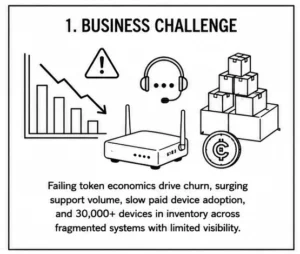
Meanwhile, the original free device model lost momentum. The paid hardware model also struggled to gain traction. After the crypto market pullback, inventory grew to more than 30,000 devices.
In addition, the company lacked a unified customer view. Customer records, device data, wallet information, ecommerce activity, support history, and outreach records lived in separate systems and were only loosley linked together.
As a result, the fragmentation limited segmentation, retention planning, lifecycle marketing, and reporting. It also made management visibility harder.
The company needed to address several issues together:
- Customer support structure and service visibility
- CRM readiness for enterprise sales activity
- Lifecycle messaging across fragmented journeys
- Ecommerce friction affecting device sales
- Excess inventory monetization
- Reporting tied to operational performance
- Future customer data unification
None of these problems existed in isolation. Declining token economics affected engagement, support, hardware demand, messaging, and reporting. Therefore, a single-system fix would not solve the larger business challenge.
Discovery and Assessment
Cimply’s initial mandate was to support a CRM implementation.
However, early discovery showed that CRM was only one part of a larger operating model issue. The company needed a connected customer operations foundation, not another isolated software project.
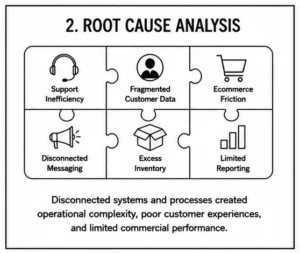
Cimply reviewed customer-facing systems, commercial workflows, and operational data. The assessment looked across ecommerce, customer support, lifecycle communications, CRM, reporting, and customer records.
The assessment included:
- CRM architecture and B2B sales process readiness
- Customer support intake, routing, prioritization, and escalation
- Ticket quality, duplication, and service desk performance
- Lifecycle email logic across marketing, Shopify, and support workflows
- Ecommerce checkout friction and device purchase barriers
- Hardware inventory sales channels
- Reporting requirements and dashboard opportunities
- Customer, device, wallet, and earnings data availability
- Segmentation opportunities for retention and reengagement
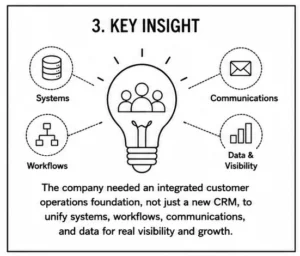
Ultimately, the discovery process reframed the work. The company needed immediate stabilization and a more scalable customer operations transformation.
Strategy and Recommendations
Cimply organized the engagement around five operating capabilities.
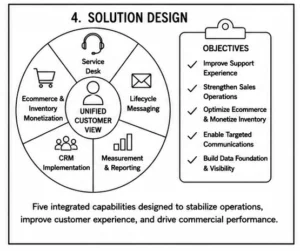
Service Desk Deployment
Standardize support intake, routing, escalation, prioritization, and service visibility.
Customer Email and Outreach Infrastructure
Create lifecycle messaging logic for onboarding, retention, reengagement, payment communication, and collections.
B2B CRM Implementation
Establish a practical CRM foundation for enterprise sales activity, lead qualification, and account management.
Measurement and Reporting
Improve visibility into support performance, customer behavior, and operational decision making.
Unified Customer View Strategy
Lay the groundwork for segmentation across customers, devices, wallets, earnings, and engagement.
This strategy prioritized practical execution. The business needed near-term improvements. However, those improvements also needed to support a more durable commercial operating model.
Moreover, each workstream had a specific role. Service desk improvements supported retention. CRM supported enterprise sales. Lifecycle messaging improved customer communication. Ecommerce fixes supported inventory monetization. Reporting made performance easier to manage.
Together, these improvements helped the company operate with greater commercial resilience.
Implementation and Execution
Building a More Scalable Customer Success Foundation
Customer support had become a major operational constraint.
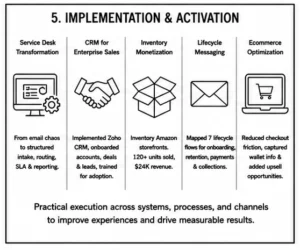
Cimply helped replace an email-driven support process with an intake-form-driven service desk. Consequently, this changed how issues entered the business. It also improved categorization, routing, and visibility across support demand.
Specifically, the work included:
- Migrating and closing more than 6,000 duplicate or outdated tickets
- Shifting ticket creation from roughly 90% email-based to 99% form-based
- Mapping ticket workflows to business lines
- Introducing escalation logic
- Helping define a minimum viable SLA model
- Creating reporting visibility for service desk performance
As a result, the company gained a more manageable customer success foundation. In addition, the work supported future managed-service revenue opportunities.
Rebuilding CRM Around Enterprise Sales Priorities
The company’s CRM environment needed to support a changing go-to-market strategy.
As the business explored enterprise use cases, CRM needed to manage opportunities more effectively. Priority markets included logistics, utilities, and public infrastructure.
Cimply implemented a fit-for-purpose Zoho CRM instance aligned with current commercial priorities.
Specifically, the CRM work included:
- Mapping and importing existing sales data
- Onboarding 12 leads, 39 accounts, and 39 deals
- Building custom intake forms for marketing qualified leads
- Designing a scalable blueprint for lead qualification
- Training the team to support adoption and feedback
This work moved CRM beyond basic implementation. Instead, CRM became a sales operations capability that supported B2B engagement.
Creating a Path to Monetize Excess Hardware Inventory
The crypto market pullback created a significant hardware challenge.
With more than 30,000 devices in inventory, the company needed new sell-through opportunities. It also needed to avoid unnecessary pricing pressure.
Cimply helped launch Amazon seller storefronts in Canada and the United States in under two weeks.
Within weeks, initial results included:
- 120+ units sold
- $24,000 in revenue
- $242 average price per unit
Additionally, Cimply recommended a broader multi-channel sales strategy. Potential channels included Walmart, Newegg, Craigslist, and Facebook Marketplace.
More importantly, this work showed that customer operations transformation was not limited to systems. Practical commercial execution also mattered.
Designing Lifecycle Email Architecture
Customer communication was fragmented across marketing, Shopify, and support workflows.
That fragmentation made it difficult to coordinate onboarding, reengagement, payment communication, collections, and other lifecycle moments.
Cimply audited the current state and defined clearer lifecycle messaging logic. The team mapped seven key messaging types across customer journeys.
Specifically, lifecycle planning included:
- Mapping customer record structures
- Defining future segmentation needs by device, wallet, and earnings
- Creating logic for lifecycle communications
- Reducing the risk of poorly targeted customer messaging
- Documenting seven lifecycle flows
Therefore, the company could improve communication before every data issue was solved. In turn, the approach reduced execution risk during CRM rollout.
Reducing Ecommerce Friction
The ecommerce experience was central to hardware monetization.
If customers faced unnecessary checkout friction, the company would lose demand when every device sale mattered.
Cimply reviewed the ecommerce experience and identified several conversion barriers.
For example, the audit found five priority issues:
- Checkout required four to five pages
- Customers could not easily edit carts or change device quantities
- Dead-end links dropped users out of the purchase funnel
- No field captured validated crypto wallet information
- Upsell and cross-sell opportunities were missing at checkout
Cimply delivered specific UI and UX recommendations. Additionally, the team created a roadmap for marketing automation and abandoned-cart recovery.
This connected ecommerce optimization to commercial strategy. The goal was not just better user experience. It was reduced friction in the path to revenue.
Improving Data and Reporting Visibility
The company had raw data, but it lacked a complete customer view.
Time-series data and wallet-level device metrics were limited. As a result, trend analysis, segmentation, and customer value modeling remained difficult.
Cimply helped improve visibility within those constraints.
Specifically, reporting work included:
- Delivering dashboards tied to service desk performance
- Proposing a methodology to unify user, device, and earnings data
- Outlining a framework for value-tiered outreach and retention
- Identifying data gaps that limited segmentation and trend analysis
This did not fully solve the unified customer view challenge. However, it created a realistic roadmap for improving customer intelligence over time.
Key Outcomes and Business Impact
The engagement produced measurable improvements across support, ecommerce, CRM, and lifecycle planning.
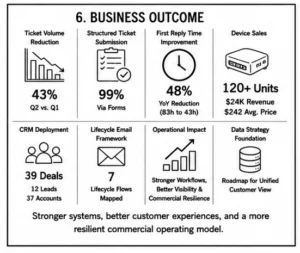
| Outcome Area | Result |
| Support System Revamp | 6,000+ duplicate or outdated tickets closed |
| Ticket Volume Reduction | 43% lower ticket volume in Q2 vs. Q1 |
| Structured Ticket Submission | 99% submitted through forms vs. 10% previously |
| First Reply Time | 48% year-over-year reduction, from 83 hours to 43 hours |
| Device Sales | 120+ units sold, $24,000 in revenue, $242 average price per unit |
| CRM Deployment | 39 deals, 12 leads, and 37 accounts onboarded |
| Lifecycle Email Framework | 7 lifecycle flows mapped and documented |
More importantly, beyond the metrics, Cimply helped the company build a more structured operating foundation.
The company gained clearer support workflows, improved CRM discipline, new ecommerce capabilities, and better service desk reporting. It also gained a practical path toward unified customer data.
Ultimately, in practical terms, the engagement moved the company from fragmented operations toward a coordinated commercial operating model.
Strategic Takeaways
Crypto-Based Models Need Customer Value Beyond Token Economics
When customer participation depends on cryptocurrency earnings, market changes can quickly disrupt engagement.
Companies need customer operations that sustain value when token incentives decline.
Operational Visibility Is a Prerequisite for Agility
Fragmented systems make it difficult to understand customers and prioritize work.
Visibility across support, CRM, ecommerce, lifecycle communications, and reporting becomes essential during disruption.
Hybrid Models Need Shared Infrastructure
Consumer, retail, and enterprise motions often require different strategies.
However, they still need shared customer infrastructure. Without it, the business cannot coordinate decisions across functions.
The Fastest Path to Scale Is Not Always More Users
In this case, growth required stronger workflows, better systems, and improved customer visibility.
Sustainable scale depended on operational discipline, not just more network participants.
Why This Engagement Mattered
This case study is not simply a CRM implementation story.
Instead, it shows how a high-growth technology company adapted its commercial operating model after the market changed.
Cimply connected strategy with execution across customer success, sales operations, lifecycle marketing, ecommerce, reporting, and customer data strategy.
The work was tactical enough to create measurable progress. However, it was strategic enough to support broader customer operations transformation.
For companies facing rapid change, that balance matters. Technology alone rarely solves operating model problems.
Sustainable improvement comes from aligning systems, workflows, data, communications, and commercial priorities.