

Overview
A multinational consumer technology and entertainment conglomerate had already invested heavily in enterprise data modernization. The effort included centralized infrastructure and governance frameworks. Enterprise-wide enablement initiatives were being led by a global consulting organization.
The technical foundation was in place. The harder challenge was turning that foundation into practical cross-business adoption.
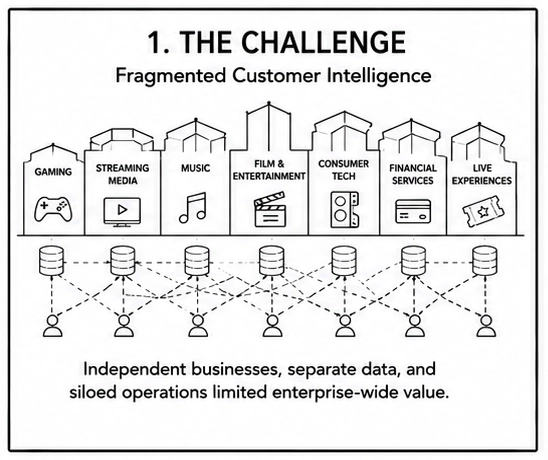
The enterprise operated a globally recognized portfolio of businesses. These included gaming, streaming media, music, film and entertainment, consumer technology, financial products, and live experiences. While these businesses served related audiences, they largely operated independently. Their customer journeys were connected, but their data and operations were not.
Each operating company maintained its own customer relationships, analytics environments, and engagement models. This created disparate activation priorities, technology stacks, and governance practices. As a result, cross-business customer intelligence remained fragmented. Related value creation opportunities were also difficult to identify.
Cimply was engaged through a strategic data and analytics partner to help bridge the gap between centralized infrastructure and practical operational adoption.
The engagement helped translate enterprise data investments into practical adoption models. It also created reusable use cases, taxonomy concepts, and product-oriented customer intelligence frameworks.
The result was a strategic framework designed to help the organization evolve from isolated enterprise data investments into a more collaborative, scalable, and operationally relevant customer intelligence ecosystem.
At a Glance
Client Type: Multinational consumer technology and entertainment enterprise
Challenge: Centralized data infrastructure existed, but cross-business adoption and participation lagged
Cimply Role: Enterprise data strategy, taxonomy development, use case normalization, customer intelligence strategy, and data product thinking
Strategic Focus: Reframe enterprise data as reusable business capabilities rather than only centralized infrastructure
Outcome: Clearer framework for enterprise customer intelligence, shared use cases, taxonomy concepts, participation models, and data product strategy
Business Value: Stronger alignment between enterprise data investments and practical business adoption
Why Centralized Data Infrastructure Was Not Enough
The organization’s businesses operated independently in many ways, despite serving overlapping audiences and participating in adjacent customer experiences.
Gaming customers also consumed streaming media. Entertainment audiences overlapped with music fans. Live experiences created additional behavioral signals. Device ownership connected content consumption and subscriptions to retail behavior, and purchase activity.
Together, these intersections created meaningful opportunities for enterprise customer intelligence. However, many of those opportunities remained underused because business units operated with separate data environments, taxonomies, priorities, and activation models.
The enterprise had invested substantially in centralized data infrastructure and identity frameworks. It had also modernized analytics environments, governance initiatives, cloud architecture. The company’s privacy and compliance modernization led naturally to clean room capabilities and customer data enablement.
The technical foundation itself was not the primary issue.
The larger challenge was organizational adoption. Specifically, business units needed a clearer understanding of how shared enterprise data could create incremental value. They also needed to understand why participation mattered, what adjacent business data could unlock, and which practical use cases justified broader collaboration.
In practice, centralized infrastructure did not automatically create enterprise value. Therefore, the organization needed a clearer operating model for packaging, explaining, and applying enterprise data capabilities around real business outcomes.
The Adoption Gap Across Business Units
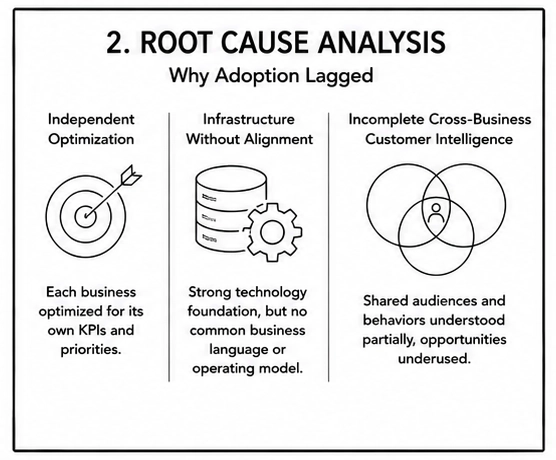
The engagement uncovered three recurring enterprise challenges.
Independent Optimization Limited Enterprise Value
Initially, most operating companies optimized around their own KPIs, customer journeys, media strategies, platforms, analytics models, and activation priorities.
This was understandable. Each business had its own commercial objectives, customer relationships, technology environment, and operational responsibilities.
However, independent optimization limited the enterprise’s ability to identify shared customer behaviors, adjacent audience opportunities, and cross-business value creation potential.
As a result, enterprise adoption remained uneven, cross-business participation was inconsistent, overlapping audiences were not fully understood, and enterprise-wide customer intelligence remained fragmented.
Infrastructure Existed, But Operational Alignment Lagged
The organization had already made substantial investments in centralized data infrastructure, cloud environments, identity systems, data governance, analytics enablement, and clean room capabilities.
However, infrastructure alone did not create organizational adoption.
The enterprise still needed a common business taxonomy and normalized use case frameworks. It also needed reusable audience intelligence products, shared reasons to participate, scalable internal data products, and common business language across operating companies.
Cimply identified that the organization needed a more product-oriented operating model around enterprise data itself.
Cross-Business Customer Intelligence Was Incomplete
Importantly, customers frequently interacted with multiple areas of the enterprise at the same time.
Those behavioral intersections created opportunities to improve personalization, audience development, cross-promotion, partnership activation, customer lifetime value modeling, and content planning.
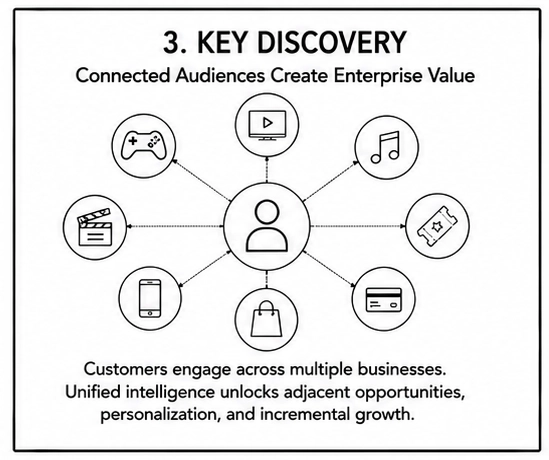
However, the organization lacked a scalable framework for linking behavioral signals, normalizing metadata, aligning taxonomies, operationalizing identity, and building reusable enterprise customer intelligence products.
As a result, this limited the organization’s ability to identify adjacent opportunities, expand audience intelligence, support cross-promotion, and accelerate innovation across operating companies.
Cimply’s Approach to Enterprise Data Product Strategy
Working through a strategic data and analytics partner, Cimply helped support the engagement by reframing enterprise data strategy around practical value creation and operational enablement.
The objective was not simply to centralize data. The objective was to help participating business units recognize, adopt, and operationalize incremental enterprise value.
Rather than focusing solely on centralized infrastructure, the engagement emphasized six areas of work:
1. Data product thinking
2. Use case normalization
3. Customer-centric taxonomy design
4. Behavioral intersection analysis
5. Operational adoption models
6. Scalable collaboration frameworks
This shifted the strategic conversation from infrastructure modernization to enterprise customer intelligence, reusable business capabilities, and practical participation models.
Discovery, Taxonomy, and Use Case Assessment
The discovery process was designed to understand what enterprise data capabilities existed. It also explored why business units were or were not using them.
First, Cimply helped evaluate stakeholder priorities, data maturity, and existing use cases. In addition, the team assessed taxonomies, identity approaches, data sources, activation models, and cross-business collaboration opportunities.
The engagement included stakeholder interviews and business maturity assessments. It also included use case evaluations, operational workflow reviews, data source inventories, identity assessments, taxonomy reviews, and cross-business capability analysis.
The work also evaluated first-party data, second-party partnerships, third-party data relationships, clean room capabilities, activation models, customer intelligence gaps, and enterprise collaboration opportunities.
This assessment helped identify shared business questions, overlapping customer behaviors, common data requirements, reusable activation opportunities, and scalable enterprise building blocks.
What the Engagement Revealed
The Businesses Had Technical Maturity, But Not Shared Operating Alignment
Many operating companies demonstrated mature engineering, analytics, activation, and operational capabilities within their own environments.
The largest gap was not technical execution. Instead, the largest gap was enterprise coordination and shared value creation.
This distinction was critical. The organization did not need another abstract technology mandate. It needed a practical model for helping business units understand how enterprise data participation could support their own business objectives while creating broader enterprise value.
Data Needed to Be Positioned as a Product
One of the most important strategic insights from the engagement was that enterprise data capabilities needed to be packaged as products that operating teams could understand, adopt, and apply.
In this context, a data product was not a standalone software product. It was a reusable enterprise capability: a defined audience framework, taxonomy, data asset, behavioral model, activation segment, or playbook that business units could use to solve practical business problems.
Business units were more receptive to packaged solutions, reusable frameworks, and defined use cases. They also responded better to playbooks, pre-built audience concepts, and practical activation opportunities than abstract infrastructure initiatives.
This led to a strategic shift toward Data-as-a-Service concepts, reusable data products, operational playbooks, internal enablement models, shared audience intelligence assets, and scalable collaboration frameworks.
Common Taxonomy Was Foundational
The engagement identified taxonomy normalization as a foundational requirement for enterprise-scale collaboration.
Without a shared business language, it was difficult to consistently connect customer behaviors, operationalize audience intelligence, or scale personalization efforts across operating companies.
Cimply helped frame a customer-centric behavioral model capable of supporting media consumption, entertainment engagement, gaming behavior, device ownership, subscriptions, demographic profiles, purchase behavior, recency, frequency, and customer value signals.
The goal was to establish a common enterprise language capable of supporting scalable customer intelligence and cross-business activation.
Shared Use Cases Created Stronger Participation Incentives
The engagement identified practical enterprise use cases capable of creating stronger participation incentives across business units.
These use cases included audience development, personalization, customer understanding, behavioral profiling, cross-promotion, partnership activation, customer lifetime value modeling, audience expansion, and content planning.
By connecting enterprise participation with practical business outcomes, the organization created a stronger operational case for collaboration.
Building a Reusable Enterprise Data Product Framework
One of the defining outcomes of the engagement was the introduction of a more scalable enterprise data product framework.
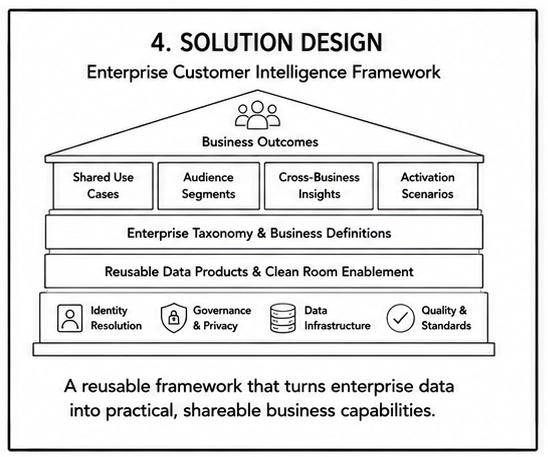
Instead of treating enterprise data solely as centralized infrastructure, the engagement proposed a different approach. Specifically, it focused on operationalizing data through reusable capabilities that business units could understand and apply.
Enterprise Data Product Components
Reusable Audience Frameworks: Standardized audience models that could be leveraged across multiple operating companies and activation channels
Activation-Ready Customer Segments: Predefined customer groupings designed for media activation, personalization, and cross-promotion
Normalized Metadata: Standardized naming conventions and classifications to improve interoperability across systems
Common Behavioral Models: Shared frameworks for measuring engagement, recency, frequency, customer value, and behavioral signals
Shared Taxonomies: Unified customer intelligence structures capable of supporting scalable collaboration
Collaboration Playbooks: Operational guidance for how business units could participate in enterprise customer intelligence initiatives
Enterprise Data Catalogs: Centralized visibility into reusable data assets, audience frameworks, and intelligence resources
Standardized Access Patterns: Consistent methods for accessing and operationalizing enterprise customer intelligence capabilities
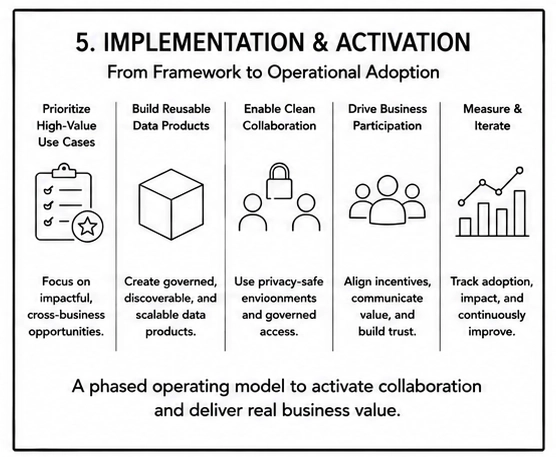
Ultimately, the long-term vision centered on scalable customer intelligence and personalization. It also supported audience targeting, cross-promotion, reach expansion, enterprise analytics, and data-informed customer journeys through a collaborative enterprise model.
Strategic Outcomes and Business Value
Ultimately, the engagement helped establish a clearer strategic direction for how enterprise data investments could evolve from centralized infrastructure into scalable business enablement capabilities.
Strategic Outcomes
• Stronger alignment around enterprise data product strategy
• Clearer positioning of enterprise data as reusable business capabilities
• Improved understanding of cross-business customer intelligence opportunities
• Stronger connection between enterprise investments and practical use cases
Operational Outcomes
• Normalized cross-business use case frameworks
• Development of common taxonomy concepts
• Improved visibility into reusable enterprise data assets
• Clearer participation and collaboration models
• Introduction of product-management principles into enterprise data strategy discussions
Business Value
• Reduced fragmentation across operating companies
• Improved ability to connect infrastructure investment to practical business adoption
• Clearer path toward personalization, audience expansion, and cross-business activation
• Stronger operational case for enterprise participation
• Better alignment between centralized capabilities and business-unit priorities
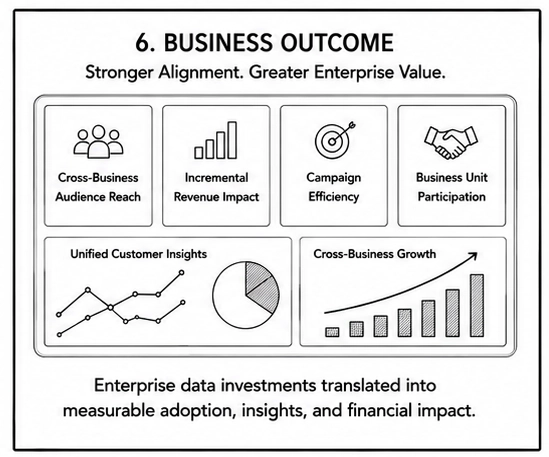
The work also reinforced a broader organizational realization: enterprise data platforms do not automatically create enterprise value.
Sustainable adoption requires operational relevance, shared incentives, practical use cases, reusable business frameworks, scalable enablement, and product-minded operational thinking.
Strategic Insight
Many enterprise organizations invest heavily in centralized infrastructure expecting adoption and business value creation to naturally follow.
In practice, that rarely happens on its own.
Enterprise data maturity is not solely defined by cloud architecture, governance frameworks, identity systems, platform investments, or clean room capabilities.
True enterprise value creation requires organizations to operationalize customer intelligence and connect participation with incentives. In addition, organizations must normalize business language, identify shared customer problems, package capabilities into reusable products, and make collaboration practical for operating teams.
As a result, the organizations that succeed are often those that treat enterprise data as more than infrastructure. Instead, they view it as a scalable internal product ecosystem designed to solve real business problems across the enterprise.
FAQ
What is enterprise data product strategy?
Enterprise data product strategy is the practice of packaging data capabilities into reusable, accessible, business-ready products that operating teams can adopt and apply. For example, these products may include audience frameworks, taxonomy models, behavioral segments, data catalogs, activation playbooks, and standardized access patterns.
Why does enterprise data infrastructure fail to create value on its own?
Infrastructure does not automatically create business value unless teams have clear use cases, common taxonomies, participation incentives, practical activation models, and shared business language. Adoption depends on whether operating teams can understand and apply enterprise capabilities to real business problems.
How does customer intelligence support cross-business value creation?
Enterprise customer intelligence helps organizations identify overlapping audiences, adjacent behaviors, personalization opportunities, cross-promotion potential, and shared growth opportunities across business units.
What role does taxonomy play in enterprise data strategy?
Taxonomy creates shared business language. It helps teams classify behaviors, audiences, products, customer signals, engagement patterns, and activation opportunities consistently across operating companies and systems.
About Cimply
Cimply helps organizations turn customer data, analytics, and marketing operations investments into practical business capabilities.
Our work connects enterprise data strategy, customer intelligence, identity, taxonomy, analytics, marketing operations, data product strategy, and operational activation so teams can move from infrastructure to measurable business value.
Whether supporting enterprise transformation initiatives or helping organizations operationalize existing investments, Cimply focuses on practical, customer-centric strategies that connect data with business outcomes.