
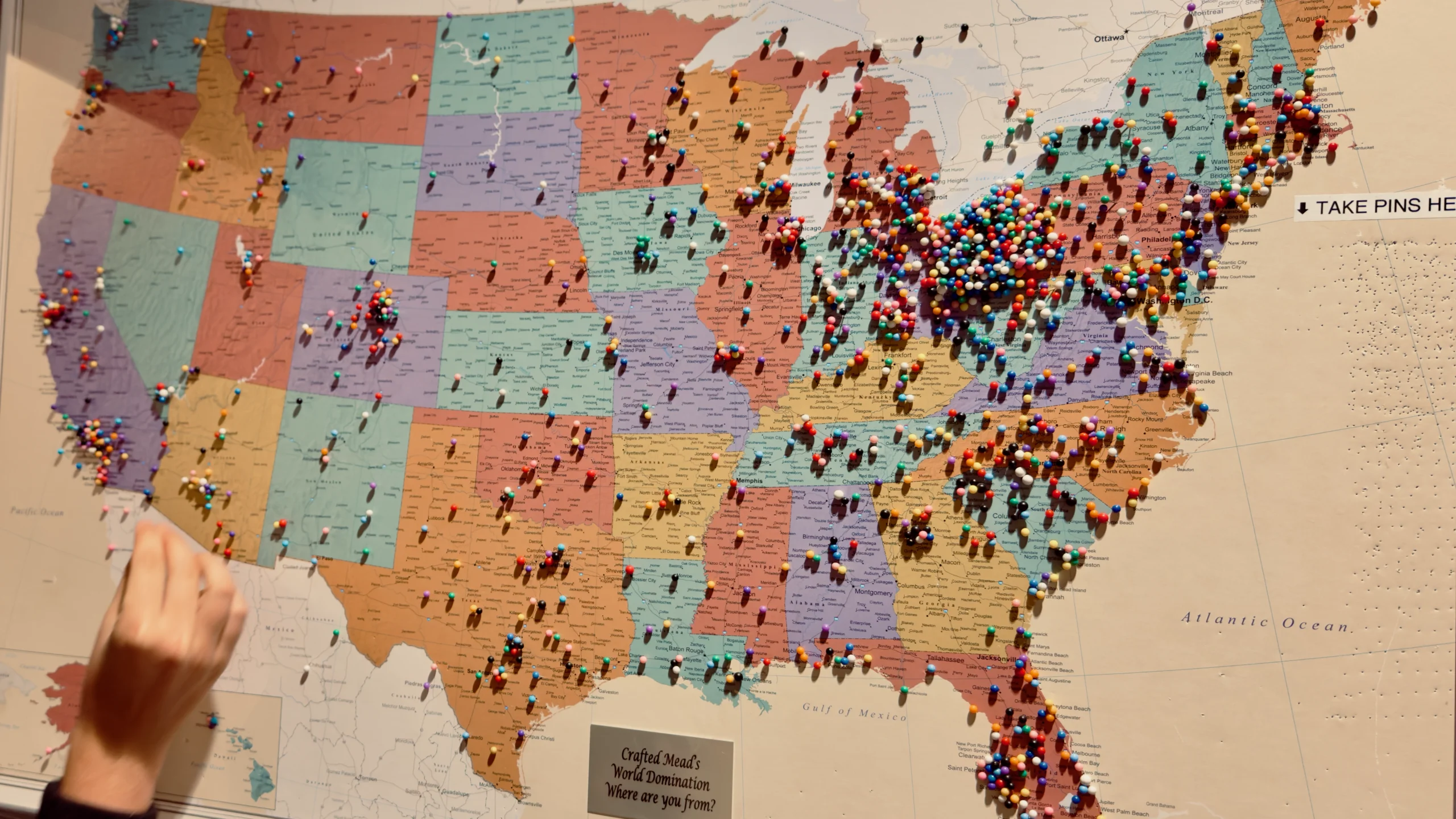
Location intelligence starts with understanding where your customers already are.
Location intelligence uses geographic context to help a business decide where to find, serve, and grow customer relationships. It can begin with information you already have and one elementary question: where do your customers come from?
In our previous article on customer intelligence, we explored what becomes possible when transaction records are connected to context. Geography is one of those connections. Customer addresses, service locations, shipping records, orders, and invoices can reveal where a business already has traction and where it may have room to grow.
My time in Army Intelligence gives me another reference point for this way of thinking. Where something happens, what surrounds it, and how it relates to other observations all help give information meaning. In business, that same habit of looking for context can turn a familiar customer map into a useful set of questions.
Start with the customers you already have
Back when I sold mailing lists and direct mail programs, establishing campaign geography was one of the first conversations we had. Where did the business operate? Which communities did it serve? Where were its existing customers?
For a localized business, promoting a service in communities it cannot economically reach wastes effort. The service area belongs near the beginning of the conversation.
Strong planning discipline dictates that geography still belongs at the beginning of a marketing plan today. Plotting customer or service addresses on a map can reveal concentrations, gaps, and unexpected patterns. Are customers clustered in a handful of neighborhoods? Will some come from farther away than expected? Which nearby communities underrepresented?
You do not need a sophisticated model to begin. A map can prompt useful questions, and so can the people closest to the customer. Ask the person scheduling appointments which towns they hear from most often. Find out where routes become difficult for delivery teams. Compare those observations with the data.
Gaps deserves investigation, not an assumption. People may not know about your company. Maybe reaching you is inconvenient or you may not serve the area efficiently. Each explanation suggests a different action.
Similar neighborhoods can reveal opportunity
There is an old saying that fits here: birds of a feather flock together.
People living in the same neighborhood often share some socioeconomic or housing characteristics. Home values, household income, family composition, life stage, housing age, and ownership can provide context for what households may need.
That leads to another practical question: are there other neighborhoods like the places where our customers already live, within an area the company can reasonably serve?
Consider a home services company with a strong customer base among older, owner-occupied houses. A nearby neighborhood with similar housing may deserve investigation. The connection is not that the residents are interchangeable. It is that the homes may create similar needs and the company already has evidence that it can serve those needs.
Existing customers provide evidence of actual demand. Similar neighborhoods give you a sensible place to test for more.
The next customer may be near today’s job
You have probably seen this idea in action without anyone calling it location intelligence.
A landscaping or pool-cleaning company completes a job and leaves a business card in a Ziploc bag with a couple of pebbles at the bottom of nearby driveways. The pebbles keep it from blowing away. The more organized (and often expensive) version uses door hangers around the homes where work is already being performed. Radius-based direct mail often makes the most sense in my experience.
The neighborhood supplies the logic: we are already working here, and other households nearby may need what we do.
Geography also affects operations. Another job nearby may fit into the schedule far more efficiently than one across town. Location intelligence can therefore influence both where a company finds demand and how economically it serves that demand.
Refine the audience around the address
A customer address can become the center of a search for nearby households with relevant demographic or property characteristics. Geography defines the area; other information helps determine who within it may be relevant.
Real estate offers a familiar example. A listing, sale, or price change can trigger communication around a property. Within that area, marketers can refine the audience using characteristics such as single-family ownership or other property information.
Pool cleaning makes the logic even clearer. A household without a pool has no need for pool cleaning, but the property alone is not enough. For many home services, we also wanted to know whether the home was owner occupied. A renter usually was not the person making decisions about landscaping, major maintenance, or other improvements to the property.
Rental homes were not necessarily irrelevant; they belonged in a different segment. The decision-maker might be an out-of-state owner or someone who owned several single-family properties. Identifying homes with pools inside the service area, then distinguishing owner-occupied properties from rentals, created a more relevant prospect universe and a clearer idea of who should receive the message.
The principle is simple: start with a location, define a useful area, then add the characteristics that matter to the offer. That understanding should guide the audience, message, and choice of channel.
Timing can make location more useful
Geography becomes even more valuable when paired with time.
A recent home purchase can create a reason to consider home improvement, decorating, landscaping, and other services. The address tells us where an opportunity may be; the purchase suggests when it might become relevant. Together, they help a business decide when to introduce a useful offer.
Research reinforces the underlying behavior. Harvard’s Joint Center for Housing Studies reported in Improving America’s Housing 2025 that recent buyers spent about 51% more on improvements than owners who had not recently moved, based on 2023 annual spending.
That does not mean every recent buyer needs the same service. A recent move combined with a relevant property characteristic provides a stronger starting point than either signal alone. Freshness matters, too. Recorded sales and commercial datasets can lag reality, so the source and update cycle should fit the decision being made.
Geography matters even more when you sell everywhere
Location intelligence is not limited to local businesses. Ecommerce retailers and brands shipping nationwide still have geographic choices to make. Where are customers buying repeatedly? Which cities or regions produce meaningful concentrations of orders? Are those markets genuinely strong, or did the company simply spend more advertising money there?
Customer volume and market penetration tell different stories. A large city can produce more orders because it has more people. A smaller market may contain a higher concentration of customers relative to the potential audience. Neither measure is enough by itself, but together they tell you where to investigate.
Inventory and distribution planning are heavily depandent on geography
I encountered another side of this as an IT manager, supporting systems concerned with inventory locations and order planning across distribution warehouses serving different markets. Geography was part of the operating picture: where the stock was, where orders were coming from, and how the warehouses related to the markets we served.
That raises practical questions for any business shipping products. Is inventory positioned near demand? Which warehouse can fulfill an order, and what does that mean for delivery time and cost? Could a promotion in one market create pressure on stock held somewhere else? Marketing plans and fulfillment plans need to reflect the same geography.
Compare shipping geography, order value, repeat purchases, marketing spend, inventory availability, shipping costs, and returns. That helps reveal where customer demand and the ability to serve it profitably line up.
The opportunity is not simply to spend more where sales are highest. It is to test whether stronger investment in markets with demonstrated, economically attractive demand produces better results.
Referrals can reinforce geographic traction
Customer relationships can also help explain why some markets become stronger than others. Friends-and-family recommendations, referrals, shared offers, and visible work in a neighborhood can introduce a business to people who were not part of the original campaign.
Some of those relationships are intensely local. A homeowner recommends the contractor working next door. A neighbor sees a landscaping crew repeatedly on the same street. Others stretch across the country, such as a customer sharing a discount code for an ecommerce brand.
Geography helps identify where that momentum appears to be taking hold, but a cluster of customers does not prove that referrals caused it. Customer feedback, referral codes, and other evidence can help explain the pattern. For marketers, the useful question is whether advertising can build on an existing base of satisfied customers, familiarity, and recommendation.
Measure the outcome rather than the mechanism alone. Additional customers, profitable sales, and repeat business matter more than the number of referral codes distributed or impressions delivered.
Follow customers beyond their home address
Home is only one part of a customer’s geography. People work, shop, commute, socialize, attend events, and spend time in places that create different opportunities.
Consider employment centers, shopping districts, entertainment destinations, intersections, and primary traffic corridors. The route between home and work may matter differently from a weekend destination. A point of interest can help explain why people are in an area, while traffic and mobility data can help describe how people move through it.
This broader view can inform out-of-home advertising, digital out-of-home screens, transit placements, and captive or place-based media networks. It can also help evaluate screens inside retail environments, waiting areas, and other places where people spend time.
A restaurant considering a roadside placement, for example, might care not only about traffic volume but direction and time of day. Is traffic moving toward the restaurant near mealtime? A brand evaluating a retail screen should ask whether the placement reaches shoppers close to a relevant purchase decision.
Digital channels can make in impact locally
The same thinking applies to streaming audio and advertising inside mobile apps. Once a business has a reason to prioritize a geographic market, these channels can provide additional ways to reach audiences there.
Location and time can also combine around events. We have explored event-triggered media concepts using time-sensitive geographic information such as incident locations, traffic patterns, and areas of interest. The planning question is not merely where something occurred. It is whether location and timing together help define a relevant market, message, and channel.
That distinction matters. Location data describes context. It does not automatically tell us what happened to a particular person, what that person needs, or whether someone saw an advertisement.
Location can help connect planning and measurement
Location intelligence can also help evaluate what happens after a marketing decision.
Learning how destination marketers use mobile location data to understand visitor traffic brought this into focus for me. Mobility-data platforms can estimate visitation patterns from sampled device data, helping analysts investigate where visitors come from, when they arrive, and how long they spend at a destination.
Those estimates can be useful, but they need to be interpreted correctly. A visit estimate is not proof that someone noticed an advertisement. Traffic counts do not equal impressions. A point-of-interest record identifies a place but does not measure visits.
The objective is to match the source to the question and understand what each signal can and cannot establish.
Useful geographic context does not have to be expensive
Businesses can begin with their own customer records and layer in public or open geographic information.
OpenStreetMap provides openly licensed roads and points of interest. The U.S. Census Bureau’s OnTheMap can help examine where workers live and work. Transportation agencies publish traffic-count information. Commercial providers can supply more curated POI and location datasets when the question requires additional detail.
These sources answer different questions. Commuting data describes home-to-work patterns rather than every trip. Road counts describe vehicle traffic, not advertising exposure. POI data tells you where places exist, not necessarily how many people visit them.
Even with those limitations, a few well-chosen layers can make a familiar market look very different.
Data is most effective when layered
One way I think about this is in three layers: foundational information about customers or businesses, changing behaviors and preferences, and the surrounding environment. Geography connects them. The useful combination depends on the decision you are trying to make.
For consumers, household composition, occupation, and homeownership can help frame a market. Combine those with purchase history, interests, or channel preferences, and the questions become more specific. An outdoor retailer might compare demand for the same product across markets with different temperatures and rainfall, then test different timing or messages. A national sales average can hide those local differences.
For a business selling to other businesses, the relevant characteristics might be industry, employee count, revenue, and number of locations. A commercial services provider could look for concentrations of suitable businesses within an economical service area. A company with one local site may require a different sales approach from a regional operator whose purchasing decisions happen elsewhere.
Environmental information adds another dimension. A major employer opening, new housing construction, or a road project could prompt a business to investigate changing demand or access. A restaurant near an employment center might examine weekday lunch patterns; one near an entertainment district might focus on evenings. Similar businesses can face very different opportunities because of what surrounds them.
These are questions to investigate, not conclusions supplied by a ZIP code. Choose the few data points that help explain customer needs, timing, access, or cost to serve. You do not need every available attribute to make a better decision.
Put location intelligence to work
A practical starting process is straightforward:
Locate your customers. Group recent customer or order records by town or ZIP code. Check missing addresses and distinguish unique customers from repeat orders.
Look for meaningful traction. Compare customer counts, repeat purchases, order value, and market size. For businesses that travel to customers, consider route density and cost to serve.
Ask what explains the pattern. Consider housing or property fit, recent moves, workplaces, shopping destinations, travel corridors, prior advertising, referrals, and other relevant context.
Choose one focused test. Select a market and an offer, message, or channel that fits the opportunity. Establish a budget and comparison period before starting.
Judge the business result. Evaluate new customers, acquisition cost, margin, repeat business, and operational impact. Then decide whether to expand, adjust, or stop.
Location also tells you where competition happens
Understanding where your customers are is only one side of the geographic picture.
For a restaurant or retailer, opportunity depends on the people who live, work, shop, travel, and spend time nearby. It also depends on the businesses competing for those same customers.
That makes trade-area analysis particularly useful. A trade area is not necessarily a neat circle around a store. Roads, commuting patterns, shopping destinations, physical barriers, population density, and competing locations can all affect how far customers will travel and which businesses they consider.
The same principle extends beyond retail. A home services company has a service area. A restaurant draws customers from a trade area. An ecommerce business can develop geographic pockets of strength. Each creates a geographic market in which the business competes for customers.
Once you understand that market, a new set of questions emerges. Where are the competitors? How much do their trade areas overlap with yours? Are parts of the market crowded with alternatives? Are there places where demand appears strong but competitive presence is relatively weak? Which businesses are pursuing the same customers you want to reach?
Location intelligence helps establish where the market exists. The next step is understanding who else shares that market with you.
That takes us from location intelligence to competitive intelligence.
Sound marketing practices outlast the tools
In the era of artificial intelligence, some of this may sound almost quaint. Know your customers. Understand where they come from. Build a quality brand. Communicate thoughtfully. Invest where you have evidence of traction. Learn from what is already working.
That is precisely why these practices deserve attention.
A business can have extraordinary technology and still overlook evidence sitting in its own customer and operating records. The tools keep changing, but understanding where demand exists and how to serve it remains essential.
Technology can help us examine patterns, connect datasets, develop communications, and execute at greater scale. Judgment still determines where to focus, what to say, what evidence to trust, and why someone should care.
Start with one practical question: where are our customers already telling us we have an opportunity?
Map the geography. Look for the pattern. Ask what explains it. Then choose one place to test a more focused effort.
Sometimes the next growth opportunity is already in view.
What would your business look like through the lens of location? Cimply can help you examine where your customers come from, connect that footprint with relevant market conditions, and identify opportunities worth testing. Bring us a question about where to grow, whom to reach, or how to focus your marketing investment. Let’s start with your customers and work outward.
Common questions about location intelligence
Do I need sophisticated data or software to get started?
No. Begin with customer addresses, service locations, or shipping records you already have. Group them by town or ZIP code, look for concentrations, and compare those patterns with what your staff hears from customers. Add outside data when you have a specific question your own records cannot answer.
How is location intelligence different from geotargeting?
Location intelligence helps you decide which places matter to your business and why. Geotargeting is one way to act on that understanding by delivering advertising within a selected area. The same insight can also guide inventory placement, a service route, or an out-of-home placement.
Should I market to everyone near an existing customer?
Proximity gives you an area to investigate. Relevance determines whom to approach. A pool-cleaning company needs homes with pools inside its service area, along with a way to reach the person who chooses the service. An owner-occupied home and a rental property may require different audiences and messages.
Does location intelligence help an ecommerce business that sells nationwide?
Yes. Compare markets using customer concentration, repeat purchases, order value, advertising spend, and fulfillment costs. A city with many orders may reflect its size or your previous spending. Look for evidence of profitable demand, then test whether a more focused investment can build on it.
How do I know whether a geographic marketing test is working?
Choose the business result before launching: new customers, acquisition cost, profitable sales, or repeat purchases. Set a budget and comparison period, and use a comparable untreated area when practical. Account for seasonality and other campaigns. Traffic, visits, and impressions provide context; they do not by themselves establish that the campaign produced additional sales.