

Overview
A leading children’s apparel brand operating across both direct-to-consumer (DTC) and retail channels was struggling to reconcile conflicting performance signals across its marketing ecosystem. What initially appeared to be a paid media performance issue ultimately revealed significant cross-channel attribution blind spots affecting business decision-making.
While retail revenue, particularly through Amazon, was growing steadily, the brand’s DTC business appeared to be underperforming significantly. Paid media teams were under pressure to improve efficiency, hit aggressive return targets, and explain why ongoing optimization efforts were not translating into stronger results.
Cimply was initially brought in to provide short-term paid search coverage during a leadership transition. On the surface, the engagement appeared straightforward. The immediate need was operational continuity during a temporary staffing gap.
However, once we stepped into the account, a deeper issue quickly emerged. The business lacked a unified cross-channel attribution view of how demand was moving across channels. As a result, teams were making decisions based on fragmented reporting, incomplete attribution, and channel-specific perspectives that did not reflect the full customer journey.
What initially looked like a paid media performance issue turned out to be a cross-channel attribution and visibility problem.
The Challenge: DTC Looked Weak While Retail Was Growing
At first glance, the situation appeared to be a standard paid media performance problem:
- Paid search campaigns were missing aggressive ROAS targets
- DTC revenue was lagging despite ongoing investment
- Teams were actively optimizing campaigns without seeing meaningful gains
From a distance, it would have been easy to conclude that the campaigns simply were not working well enough. A closer review revealed a more complicated picture.
Channel Fragmentation
Paid search and social teams operated largely independently from the retail and Amazon teams. Each group had its own reporting structure, priorities, and performance conversations.
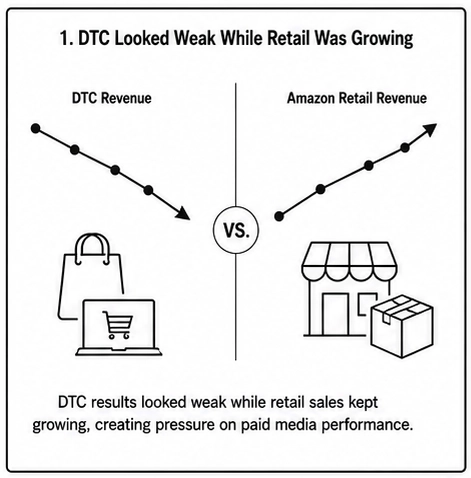
As a result, no one had a complete view of total demand across the business.
The paid media team was being evaluated heavily on DTC performance, while retail channels were showing signs of strength. Those realities were being discussed separately, without a shared measurement framework to connect them.
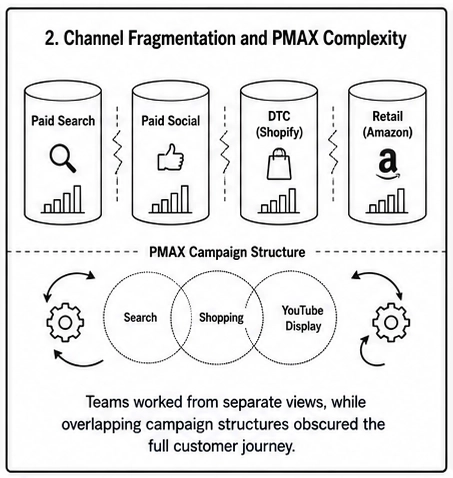
Platform-Level Bias and PMAX Complexity
There were also structural issues inside the Google Ads environment, particularly within Performance Max (PMAX).
Branded and non-branded demand were blending together in ways that obscured performance signals. Product categories overlapped, campaigns competed for similar demand, and budget allocation was not always flowing cleanly to the intended business priorities.
In a retail environment with hundreds of SKUs across multiple apparel categories, those overlaps can create significant reporting noise and attribution distortion.
Incomplete Measurement Across Channels
Most importantly, the business lacked a unified dataset across Shopify and Amazon.
The team could clearly see:
- DTC performance was under pressure
- Amazon revenue was growing
What they could not answer confidently was the most important question:
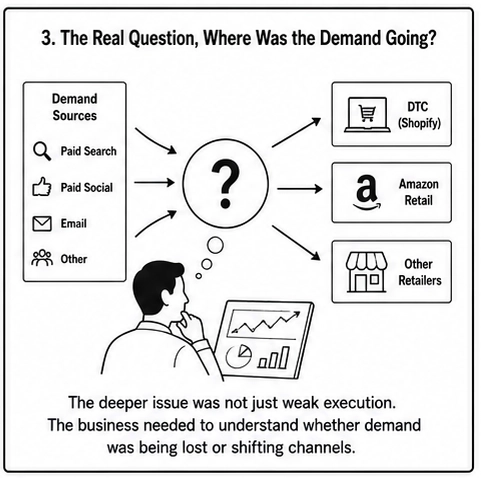
Was the business actually losing demand, or was demand simply moving somewhere else?
The Real Question: Where Was the Demand Going?
Cimply’s first responsibility was to stabilize the account operationally during the paternity leave coverage period.
That included:
- Taking over day-to-day paid search management
- Maintaining campaign execution and QA workflows
- Supporting ongoing optimization efforts
- Ensuring continuity with minimal disruption
This was not a moment for dramatic reinvention. The business needed stable execution, clear communication, and operational consistency.
At the same time, we conducted a light structural audit of the account.
The review identified:
- overlap between branded and non-branded PMAX traffic
- inefficient product-level targeting structures
- budget allocation conflicts
- campaign competition for similar demand
These findings did not point to catastrophic account mismanagement. However, they did reveal operational inefficiencies and, more importantly, provided historical context for why performance reporting appeared inconsistent.
As we worked across the account and spoke with stakeholders from different parts of the business, the more important issue began to emerge.
The retail team described growth.
The DTC team described underperformance.
That contradiction changed the framing of the engagement.
Instead of continuing to ask:
“Why is paid search underperforming?”
We reframed the question:
“Where is the demand actually going?”
That shift ultimately became the turning point in the engagement.
Building a Cross-Channel Attribution Framework
To answer the question properly, Cimply gained direct access to:
We then:
- aggregated daily revenue by channel
- aligned time-series reporting across datasets
- built comparative trend models
- evaluated shifts in channel share over time
This allowed the conversation to move away from channel-specific opinions and toward a business-level analysis grounded in actual performance data.
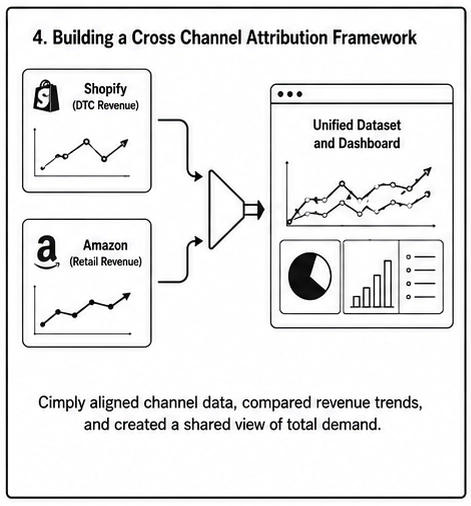
From there, we analyzed:
- revenue trends over time
- changes in channel contribution
- directional relationships between Amazon growth and DTC performance
- the downstream impact of paid media activity across channels
The findings were difficult to ignore.
As Amazon revenue increased, DTC revenue declined proportionally. The pattern was visible across multiple reporting periods and consistent enough that it could not reasonably be dismissed as short-term volatility or seasonality alone.
Demand was not disappearing.
Demand was moving.
What the Cross-Channel Data Revealed
The analysis revealed that the business was not dealing with a simple paid media execution problem but rather a significant cross-channel attribution challenge.
It was dealing with cross-channel demand displacement.
As investment and sales activity increased on Amazon, more customer purchases shifted away from the brand’s owned ecommerce experience.
At the same time, paid search campaigns, particularly broader PMAX structures, were likely contributing demand into the overall retail ecosystem in ways that were not visible within last-click DTC reporting.
In practical terms:
- the business was still generating demand
- customers were still converting
- revenue was still growing in parts of the ecosystem
However, the attribution model made it appear as though paid media was failing because too much evaluation was tied exclusively to DTC outcomes.
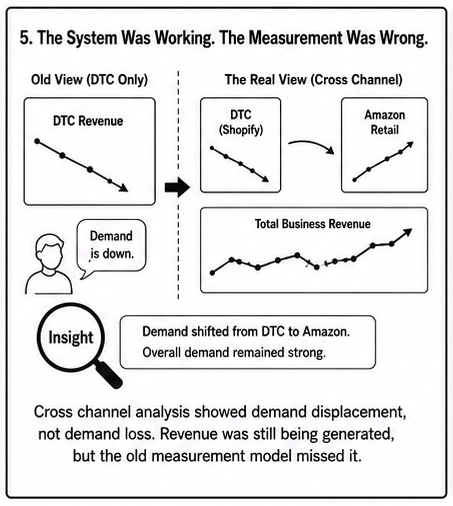
The system was working better than the measurement suggested.
Or more simply:
The system was working. The measurement was wrong.
Artifacts and Visual Evidence
To make the findings usable across teams and leadership groups, Cimply developed a series of executive-ready analytical views.
Weekly Revenue Trends
Comparative weekly trend analysis showed clear divergence as Amazon revenue scaled while DTC softened.
Monthly Revenue Breakdown
Monthly views highlighted the growing retail contribution to total revenue and made the changing channel mix easier to visualize.
Channel Share Analysis
Channel share reporting quantified how revenue composition shifted over time and helped frame the discussion around demand displacement rather than demand loss.
Quarterly Aggregation
Quarterly rollups reinforced that the trend was not isolated volatility. The pattern represented a structural shift in how customers were converting across channels.
These visuals proved especially important because the issue was difficult to explain through campaign metrics alone. Once the data was aligned and viewed across channels, the business story became much easier for stakeholders to understand.
Business Impact and Outcome
Immediate Operational Stability
The engagement delivered continuity during a critical leadership gap.
Campaign execution remained stable, optimization efforts continued without disruption, and the business maintained operational consistency during a high-pressure period.
A Clearer Executive Narrative
Beyond operational support, Cimply helped the organization develop a more accurate explanation for what was happening across the business.
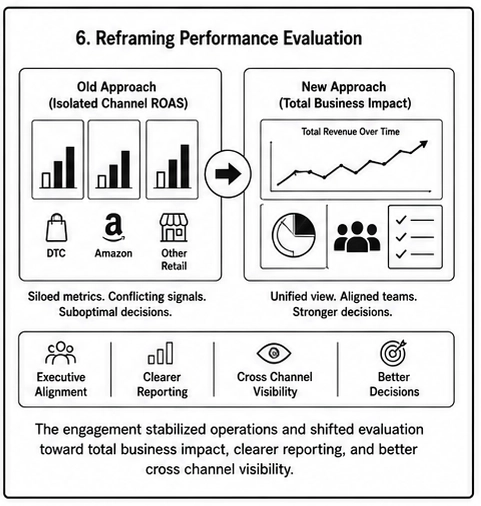
Instead of evaluating paid media solely through a DTC lens, stakeholders were able to view performance through a broader cross-channel framework tied to total business impact.
That changed the conversation significantly.
Reframing Performance Evaluation
The engagement helped shift internal thinking away from isolated channel efficiency metrics and toward a more complete understanding of customer behavior across the retail ecosystem.
This reduced the risk of:
- over-correcting paid media performance
- misallocating budget decisions
- evaluating teams against incomplete attribution models
Strategic Insight Beyond the Engagement
The work surfaced a measurable case of channel cannibalization and demand shifting between Amazon and DTC channels.
More importantly, it reinforced the need for:
- stronger coordination between retail and media teams
- unified ecommerce measurement frameworks
- better visibility into cross-channel customer behavior
The fact that Cimply was later asked to return for additional coverage reinforced the broader value of the engagement. The work did not simply maintain operations. It created strategic clarity at an important moment for the business.
Key Takeaways for Marketers
Channel Performance Is Not Business Performance
If you are only measuring DTC performance in isolation, you may be missing where growth is actually occurring across the business.
That creates risk not only in campaign optimization, but also in how teams are evaluated and investment decisions are made.
Platforms Optimize for Themselves
Google and Amazon are both highly effective demand capture environments. Neither platform is responsible for helping you understand how they interact with one another.
That responsibility belongs to the marketer.
Without a framework for understanding cross-channel attribution, businesses can unintentionally optimize against their own growth.
PMAX Requires Guardrails
Performance Max can be effective, but blended campaign structures without clear controls can:
- cannibalize branded demand
- distort attribution signals
- create internal competition across campaigns
- make diagnosis significantly harder
You Cannot Optimize What You Cannot See
Without unified data across channels, marketers are often making decisions with incomplete visibility.
In some cases, they may even be optimizing against business growth while believing they are improving efficiency.
Where This Fits in Cimply’s Services
This engagement reflects how Cimply’s planning, activation, and analytics capabilities work together in practice.
Planning
- cross-channel strategy alignment
- retail demand flow analysis
- performance evaluation frameworks
Activation
- interim paid search ownership
- campaign QA and optimization
- operational continuity support
Analytics
- cross-channel revenue modeling
- ecommerce measurement analysis
- executive-ready reporting and insights
Closing Thought
Most brands do not have a performance problem as much as they have a visibility problem.
When channel teams operate in silos and measurement stops at the platform or last-click level, it becomes easy to misread what the business is actually telling you.
Until you understand how demand moves across your ecosystem, you are not truly optimizing growth.
You are just reallocating credit.