
Executive Summary
This marketing operations case study examines how SoundHound strengthened its operating model for growth during a major business transition.
SoundHound has deep technical roots and an established enterprise sales motion. The company serves complex markets such as automotive, connected devices, and technology. At the same time, it was pursuing faster-cycle retail, restaurant and food service opportunities.
As one might expect, the shift created new pressure on marketing, sales, and reporting. SoundHound needed better lead management, stronger campaign planning, clearer attribution standards, and more useful revenue visibility.
Cimply partnered with SoundHound to improve the overall marketing operations structure behind this transition. The work included discovery, process mapping, assessment of data readiness, lead lifecycle optimization, campaign planning standards, UTM governance, Salesforce visibility, and development of reporting requirements.
As you will read in this marketing operations case study, SoundHound reported meaningful improvements in multiple funnel metrics. Marketing qualified leads increased by 250%. Conversion rate improved by 130%. Conversion to sales qualified leads increased by 119%, and qualified opportunities increased by 40%.
More importantly, the work helped SoundHound build a more scalable operating model. A leaner marketing organization could support growth with better consistency, efficiency, and accountability.
Engagement Snapshot
Client
SoundHound AI
Industry
Conversational AI and voice AI
Business Context
SoundHound AI had recently gone public and was evolving from a long-cycle enterprise and OEM sales model toward a more disciplined growth model. It also needed to support faster-cycle restaurant solutions.
Primary Challenge
SoundHound needed stronger visibility into lead quality, lifecycle progression, campaign performance, attribution, and marketing contribution.
Focus Areas
- Marketing operations
- Lead lifecycle optimization
- Campaign planning
- UTM and naming standards
- Salesforce visibility
- Attribution readiness
- Reporting and measurement
- Sales and marketing alignment
- Process documentation
- Scalable execution by a leaner team
Reported Results
- 250% increase in marketing qualified leads
- 130% improvement in conversion rate
- 119% increase in conversion to sales qualified leads
- 40% increase in qualified opportunities
Strategic Impact
Cimply helped SoundHound connect campaign planning, lead management, data flow, attribution, reporting, and sales alignment into a practical growth system.
Client Background
SoundHound is a conversational AI and voice intelligence company. It helps organizations create natural language experiences across phone, web, mobile, automotive, connected-device, restaurant, and enterprise environments.
The company began with deep technical roots in audio and music recognition. Over time, it evolved into a broader voice AI platform.
As SoundHound entered a new stage of commercial maturity, expectations changed. The company needed more operating discipline, revenue visibility, investment clarity, and efficient execution.
Historically, SoundHound served complex enterprise and OEM opportunities. Those opportunities often involved longer sales cycles, larger technical requirements, and more involved sales support.
At the same time, the company was pursuing restaurant and food service opportunities. Phone ordering, drive-through solutions, and similar use cases created a different commercial motion.
These opportunities required faster learning cycles. They also required clearer lead qualification, repeatable follow-up, and better measurement across the funnel.
As a result, SoundHound needed to support two realities at once. It had to serve complex enterprise markets while building a faster and more scalable demand generation model.
The Challenge: Scaling Growth With More Discipline, Speed, and Visibility
SoundHound was not facing a simple lead generation problem. It was facing a marketing operations challenge.
Consequently, the company needed better answers to several business questions.
- What qualifies a lead for marketing follow-up?
- How should a lead move to sales?
- When should a lead enter nurture?
- Which campaigns, channels, audiences, and use cases create meaningful opportunities?
- How should sales and marketing share definitions, expectations, and accountability?
- What campaign information must teams capture before launch?
- In what way should marketing contributions be reported to business leaders?
- Can a leaner team support more activity with less manual coordination?
Commercially speaking, these questions mattered. SoundHound needed to support growth while improving efficiency.
Managing enterprise complexity while pursuing faster-cycle restaurant opportunities was a priority. Therefore, leaders needed clearer visibility into pipeline contribution and campaign performance.
Without stronger operating discipline, marketing activity could increase without better decision-making. Teams could generate more leads but still struggle to prioritize spend, improve conversion, or forecast opportunity creation.
Several constraints limited scalability:
- Lead-stage definitions needed clearer governance.
- Marketing and sales handoffs needed stronger qualification rules.
- Campaign planning varied across initiatives.
- UTM structures and naming standards needed more discipline.
- Data flows between systems lacked documentation.
- Campaign inputs were not always structured for reporting.
- Salesforce visibility needed to support lifecycle and pipeline questions.
- Reporting needed to connect marketing activity to business outcomes.
- A leaner team needed repeatable processes that reduced manual work.
The business opportunity was real, especially in restaurant and food service. However, the operating structure behind demand generation needed to mature first.
Discovery and Assessment
Cimply began by evaluating the operating systems behind SoundHound’s marketing and revenue motion.
Initially, we examined how leads were generated, captured, routed, qualified, nurtured, reported, and connected to sales activity. At the same time, observing how campaign data moved through the business.
Our evaluation included stakeholder discussions, process reviews, campaign planning evaluations, lifecycle mapping, data flow analysis, reporting assessment, Salesforce-related requirements gathering, and the Data Readiness Assessment.
Identification of isolated marketing tactics was not the goal. Instead, Cimply examined how strategy, process, data, systems, reporting, and execution worked together.
Lead Lifecycle
Cimply evaluated how prospects moved from initial engagement into defined lifecycle stages.
Lifecycle stages included brand qualified lead, marketing qualified lead, contact validation, sales accepted lead, sales qualified lead, nurture, disqualification, and opportunity creation.
Marketing Operations
Cimply reviewed how campaigns were planned, approved, trafficked, tracked, launched, measured, and optimized.
Workflows needed to support media, creative, landing pages, email, content, retargeting, and sales follow-up were all monitored closely.
Sales and Marketing Alignment
Cimply assessed lead handoff procedures, qualification criteria, feedback loops, ownership expectations, and sales follow-up needs.
In the heat of the moment, this helped clarify what sales teams needed before they could act on leads with confidence.
Data Readiness
Cimply’s Data Readiness Assessment examines data quality, governance, system integrations, inbound data standards, customer journey data, tag management, UTM design, audience development, and reporting inputs.
Marketing performance depends on trusted data and consistent processes.
Attribution Readiness
Evaluation of how SoundHound could connect marketing activity to leads, opportunities, campaign sources, creative versions, audiences, content, channels, and pipeline contribution was a significant step.
Diligently designing the organization for more reliable marketing attribution.
Reporting and Measurement
Assessment and development of dashboard requirements, marketing scorecard needs, campaign-level measures, lead quality visibility, opportunity reporting, and executive decision-making needs.
Ultimately, the discovery revealed two priorities. First, SoundHound needed immediate operational improvements. Second, it needed a more scalable measurement model.
Strategy and Recommendations
Cimply’s strategy centered on one practical operating question.
What is a qualified lead, and how should that lead move through the business?
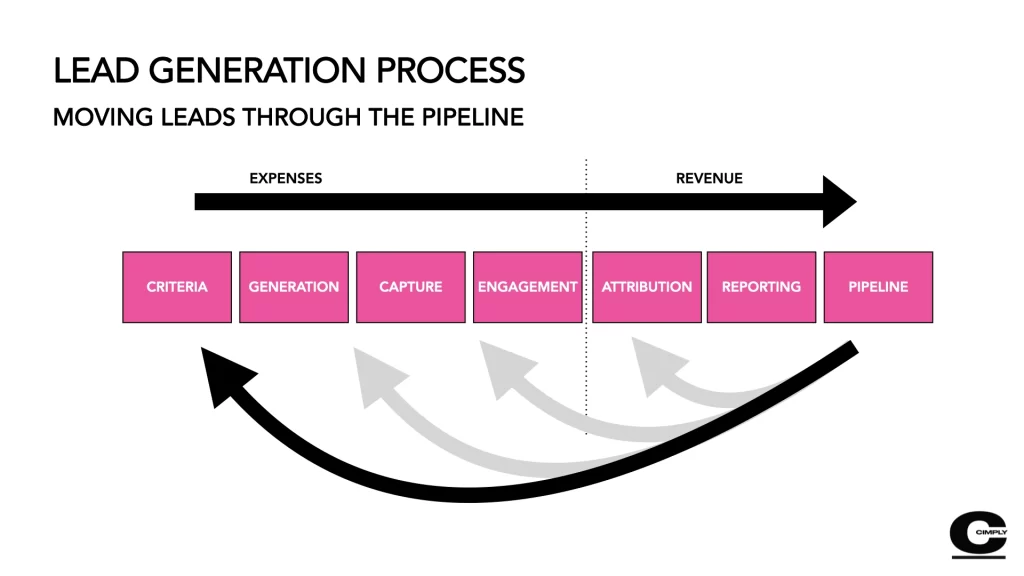
Answering that question required more than a definition. It required a connected operating model for lifecycle governance, campaign planning, data capture, attribution, reporting, and sales coordination.
Lifecycle Governance
Our first priority was to establish clearer rules for how leads entered, moved through, and exited the funnel.
This included definition and governance around:
- Brand qualified leads
- Marketing qualified leads
- Contact validation
- Sales accepted leads
- Sales qualified leads
- Qualified paths
- Unqualified paths
- Disqualification paths
- Nurture eligibility
- Retargeting paths
- Sales and marketing feedback loops
- Lead-stage criteria
- Lifecycle progression rules
Logical structure reduces ambiguity. It also gives marketing, sales, and leadership a shared way to interpret funnel performance.
Campaign Planning and Operational Discipline
Cimply recommended a more structured campaign planning process. The process needed to support repeatability, accountability, and measurement.
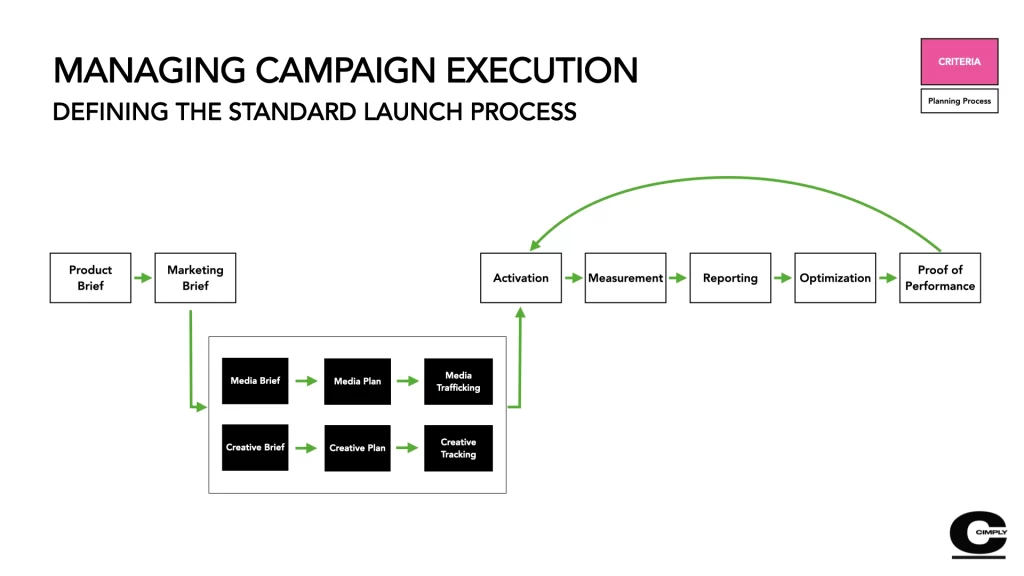
Our recommended model connected:
- Product briefs
- Marketing briefs
- Media briefs
- Creative briefs
- Media plans
- Creative plans
- Trafficking sheets
- Creative tracking grids
- Audience definitions
- Budget allocation
- Landing page strategy
- Call-to-action planning
- Reporting requirements
- Optimization planning
- Proof of performance
Implementing this model was especially important for faster-cycle restaurant opportunities. Campaigns needed to be easier to launch, track, compare, and improve.
Attribution and Tracking Standards
SoundHound needed more reliable ways to understand where leads and opportunities came from.
Cimply helped define standards for:
- UTM governance: source, medium, campaign, content, creative, term, asset, and network fields
- Campaign naming conventions
- Creative naming conventions
- Pardot and Salesforce field considerations
- Event naming
- Page source tracking
- Audience and segment tracking
- Campaign-to-Salesforce alignment
- Contribution analysis requirements
Attribution doesn’t exist for its own sake. Instead, SoundHound needed to understand which channels, audiences, creative approaches, content assets, and use cases contributed to qualified demand.
Reporting and Measurement Framework
Cimply recommended a reporting approach that could answer operational and executive questions.
Important questions included:
- What percentage of leads convert to meetings?
- What percentage of leads convert to opportunities?
- What is the cost per meeting or opportunity by channel and industry?
- Which content is consumed by leads who convert?
- Which pages are visited by qualified leads?
- Which channels and campaigns produce a meaningful pipeline?
- How do opportunity count, deal value, win rate, sales cycle, and pipeline value differ by source?
- Where can marketing contributions be seen across the customer journey?
These requirements moved reporting beyond activity tracking. As a result, leaders could focus more directly on business performance and pipeline contribution.
Implementation and Execution
Cimply’s role extended beyond assessment and recommendations.
The engagement included practical implementation support across lifecycle governance, campaign operations, attribution planning, reporting requirements, process documentation, and cross-functional coordination.
Lifecycle and Lead Management
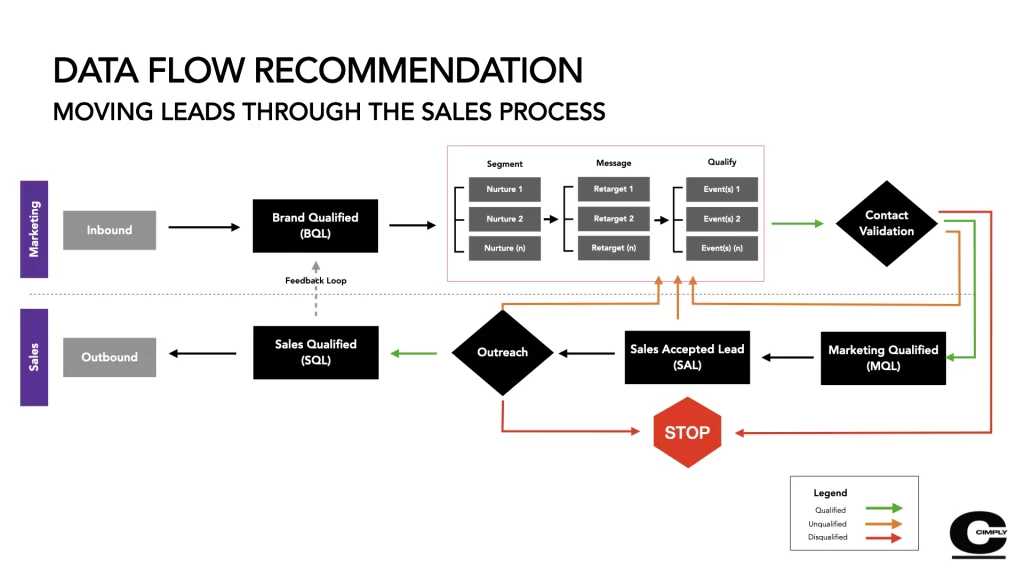
Cimply helped clarify how leads moved through the funnel.
The model included inbound and outbound sources, BQL, MQL, contact validation, SAL, SQL, nurture, retargeting, qualified outcomes, unqualified outcomes, and disqualification paths.
This work created a clearer structure for routing, handoff, follow-up, and measurement. It also helped sales and marketing teams use a common view of lead quality.
Campaign Planning and Media Operations
The engagement introduced a more structured launch process for campaign planning and execution.
This included templates and workflows for briefing, planning, trafficking, creative tracking, budget allocation, channel coordination, activation, reporting, optimization, and proof of performance.
Consequently, SoundHound gained more repeatable campaign discipline. The work also supported a shift toward managing more media process knowledge internally.
UTM, Naming, and Attribution Structures
Cimply helped develop standards for campaign tracking, UTM structures, naming conventions, audience identification, creative context, asset tracking, and source-of-origin visibility.
These standards created a cleaner connection between campaign execution and downstream reporting. They also supported Salesforce campaign alignment and future contribution analysis.
Reporting and Dashboard Requirements
Cimply supported requirements gathering for an MVP reporting model and marketing scorecard.
The work connected lead sources, funnel stages, campaign activity, content engagement, meeting conversion, opportunity creation, pipeline value, and business outcomes.
The reporting model needed to serve both operational teams and executive stakeholders. Therefore, Cimply focused on the path from campaign execution to performance interpretation.
Documentation and Enablement
The engagement included business and technical requirements documentation.
This documentation supported ongoing work across marketing operations, sales operations, and activation teams. It mattered because SoundHound needed repeatable processes that a leaner team could maintain and improve.
Building a Scalable Marketing Operations Model
The immediate value of the engagement was better lifecycle visibility and greater operational clarity.
The broader value was the marketing operations model it helped create.
By clarifying lead definitions, strengthening campaign planning, improving tracking standards, and defining reporting requirements, SoundHound gained capabilities that extended beyond one campaign or channel.
The company developed a more consistent way to plan activity, capture data, route leads, understand performance, and connect marketing execution to pipeline.
The work also created a foundation for future initiatives involving:
- Marketing performance reporting
- Salesforce visibility
- Marketing influence measurement
- Pipeline reporting
- Demand generation leadership support
- Sales and marketing alignment
- Media activation discipline
- Lifecycle governance
- Revenue operations maturity
Ultimately, the engagement showed the value of connecting strategy, operations, data, reporting, and activation into one practical growth system.
Key Outcomes and Impact
Performance Outcomes
Following the engagement, SoundHound reported measurable improvements across key funnel indicators:
Marketing qualified leads increased by 250%.
Conversion rate improved by 130%.
Conversion to sales qualified leads increased by 119%.
Qualified opportunities increased by 40%.
These results reflected a stronger ability to generate, qualify, and advance demand through the funnel.
However, the outcomes should be viewed in the context of a broader operating improvement effort. They should not be treated as the result of one isolated tactic.
Operational Outcomes
The engagement also improved the operating environment behind those results.
Key operational outcomes included:
- Clearer lifecycle governance
- More consistent lead-stage definitions
- Better sales and marketing handoff structure
- Improved campaign planning discipline
- Stronger UTM and naming standards
- Better visibility into lead quality and source of origin
- More structured reporting requirements
- Stronger attribution readiness
- Better connection between marketing activity and pipeline contribution
- Improved ability for a leaner team to support growth activity
- More repeatable execution across campaigns, channels, and use cases
SoundHound stakeholders highlighted improvements in marketing operations, analytics, lead lifecycle management, reporting quality, Salesforce visibility, data quality, attribution understanding, reporting accessibility, and lead routing processes.
Strategic Takeaways
Many organizations try to improve growth by increasing marketing activity. SoundHound’s experience shows that growth also depends on the operating systems behind that activity.
For companies moving into new markets, marketing operations become a strategic capability. The same is true for companies shifting revenue motions or operating with greater financial discipline.
Lead definitions, campaign planning, attribution standards, reporting structures, and sales handoffs all matter. Together, they determine whether teams can learn quickly, act efficiently, and invest with confidence.
This marketing operations case study shows that performance is not only about more campaigns or more leads. It depends on whether a business can understand lead quality, route demand effectively, measure contribution, and improve the customer journey.
By helping SoundHound strengthen these capabilities, Cimply helped create a more scalable growth operating model. That model supported public-market expectations, enterprise complexity, and faster-cycle restaurant opportunities.
TESTIMONIALS
“Cimply provided strategic leadership and tactical guidance in the optimization of the lead lifecycle performance of our artificial intelligence company. The customized lead lifecycle optimization developed and implemented helped the company to improve marketing and sales efforts and increase the number of marketing qualified leads by 250%. The Cimply team has been invaluable in helping the entire growth team with digital lead generation planning, marketing operations and analytics. They are the glue that holds the team together and allows us to do the best work we can do.”
Andrew W., Head of Demand Generation and Digital Marketing
“The accuracy and quality of the data has improved dramatically. It is much easier to create reports and our ability to understand influence and attribution in Salesforce is much stronger. The business leaders can now find many answers on their own much faster. The 2023 lead routing process is much better. If I had to go back to the 2022 state of affairs, I would pull my hair out.”
Deepa K., Senior Manager, Marketing Analytics & Operations
Frequently Asked Questions
What is marketing operations?
Marketing operations is the structure behind marketing execution. It includes processes, governance, data standards, reporting, workflows, systems, and measurement practices that help marketing connect activity to business outcomes.
What is lead lifecycle optimization?
Lead lifecycle optimization defines and improves how prospects move from initial engagement to marketing qualification, sales acceptance, sales qualification, opportunity creation, and customer acquisition.
Why is attribution readiness important?
Attribution readiness helps organizations understand where qualified demand comes from. It depends on campaign tracking, naming conventions, source capture, Salesforce alignment, and clear reporting requirements.
How does sales and marketing alignment improve pipeline performance?
Sales and marketing alignment gives both teams shared lead definitions, qualification standards, handoff rules, follow-up expectations, and reporting structures. This improves lead quality and pipeline visibility.
What is a Data Readiness Assessment?
A Data Readiness Assessment evaluates whether an organization can support data-driven decision-making. It examines governance, data quality, system integrations, reporting, measurement, privacy considerations, and operational processes.